Showing posts with label jose rizal. Show all posts

Wednesday, April 4, 2012

Camarines Norte: A stroll through history


By: 


share473 456

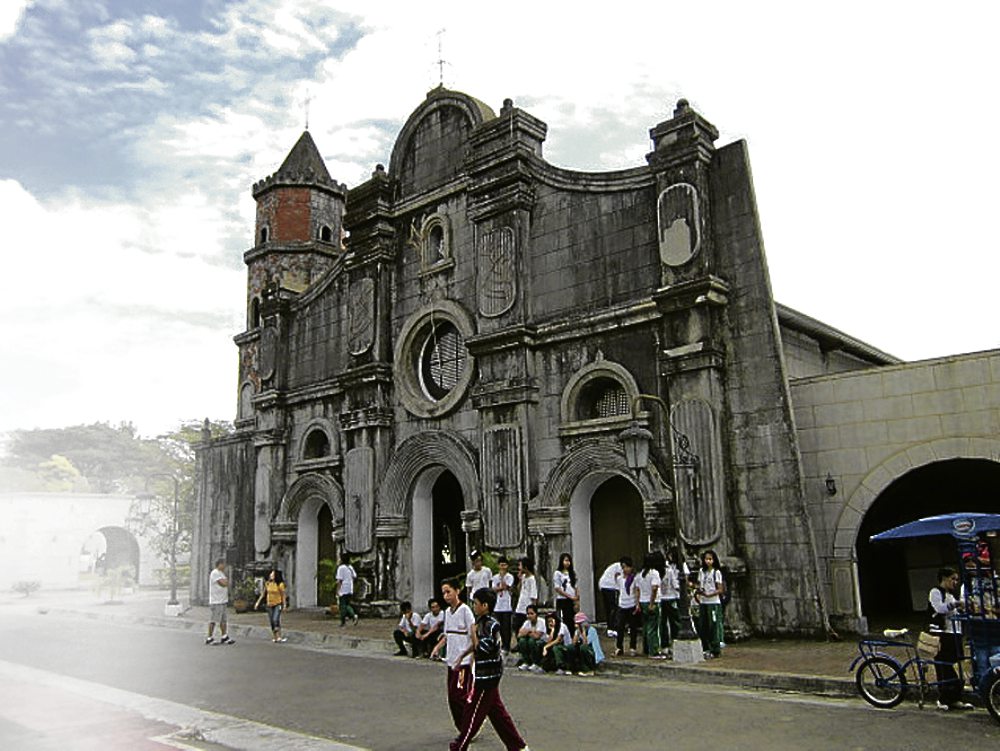
FAÇADE of historical church of Lobo
A walk in and around Daet, capital of Camarines Norte, is a stroll through history, a heritage mini-tour. There are historical churches, museums, landmarks and monuments to the past.
In Paracale, a town that sits on gold (said to be stolen by a former president), is the Church of Our Lady of Candelaria, which is celebrating its 400th anniversary. The parish has huge adobe blocks and strong shafts of hardwood cut from the forests during Spanish times.
The story is that Our Lady fought off invading Moros and her finger was cut off. A gold finger (shades of James Bond) was placed on her hand but this always fell off.
Our Lady would not receive the substitute gold finger, and the paint would always peel off. And so the icon was left minus one finger.
What is in the retablo (altar backdrop) today, however, is a replica.
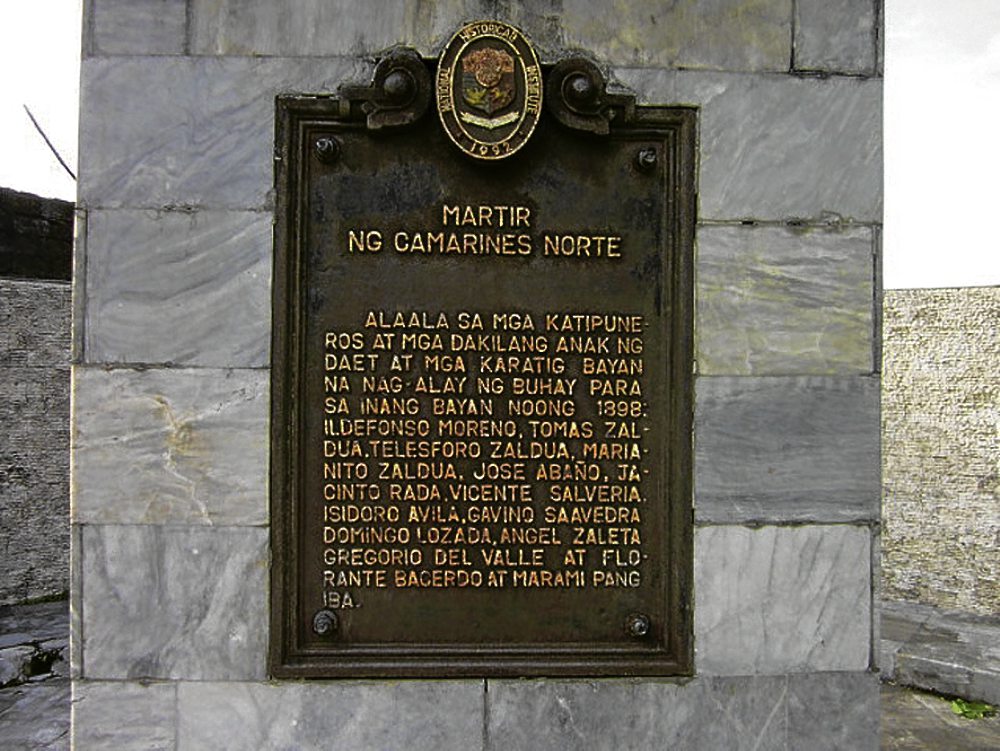
MEMORIAL to 1898 martyrs
Another cultural treasure is the Baroque Church of Labo. Its belfry has a “wedding cake” motif similar to the famous church tower in Tumauini, Isabela.
Labo also has an interesting museum.
The people of Camarines Norte, especially Daeteños, are particularly proud of the first monument to Rizal in the Philippines, which is in town plaza. A 1961 plaque of the Philippine Historical Committee notes that the monument was built through voluntary donations of the people, as solicited by Lt. Col. Ildefonso Alegre and Lt. Col. Antonio Sanz of the revolutionary army.

RUFINO Pabico ancestral house, a cultural treasure
The simple, stately and whitewashed landmark, with a golden star, is dedicated to the National Hero in Spanish: “A José Rizal.” At the base is the year the novel “Noli Me Tangere” was published: 1891. The monument was unveiled on Dec. 30, 1898.
Another shrine in the plaza honors the martyrs who fought the Spaniards and died in 1898, when the revolution against Spain resumed following the arrival of the Americans. The marker notes that the heroes defeated the Spaniards at first, but “freedom was short-lived.” Fifty names are etched on the shrine.
Cut to World War II, where the Lamitan Battle Memorial pays tribute to the gallant stand of the guerillas against the Japanese invaders in December 1941, in one of the first battles of WWII.
Nearby in the imposing provincial capitol, is the Museo Bulawan, the community museum of Camarines Norte where many activities and exhibits have taken place. What attracted the visitor from Manila was the Amorsolo Corner, a tribute to our first National Artist, Fernando Amorsolo, who grew up in Daet.
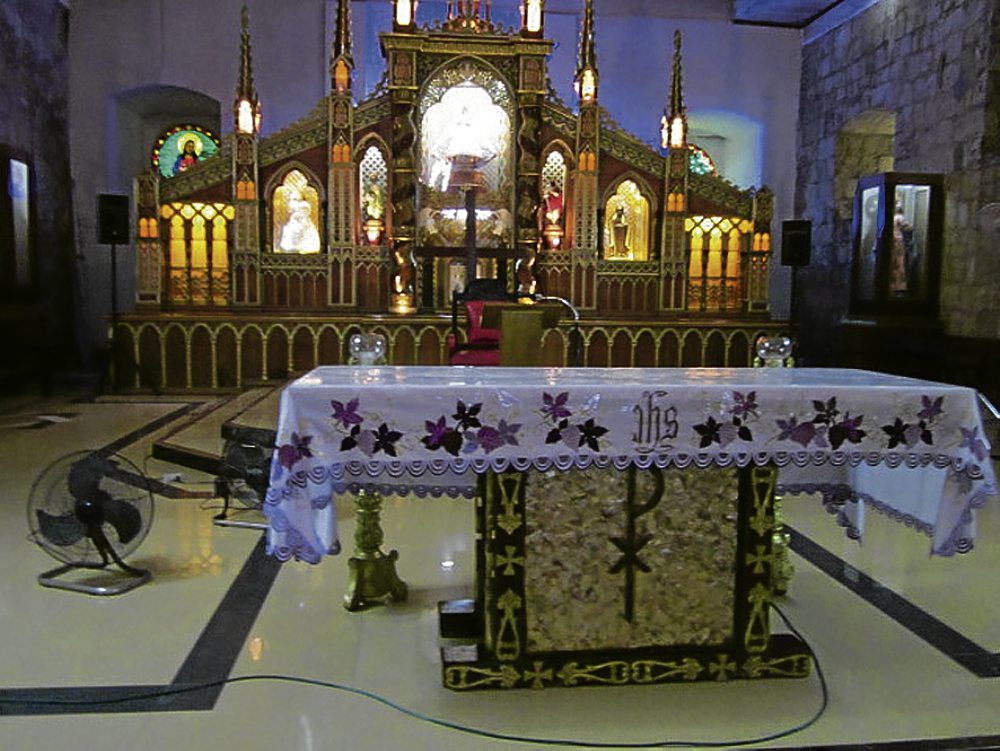
PARACALE altar and retablo
On display are 1920s magazines that published the drawings, sketches, nudes and carnival posters of the master.
Tour climax
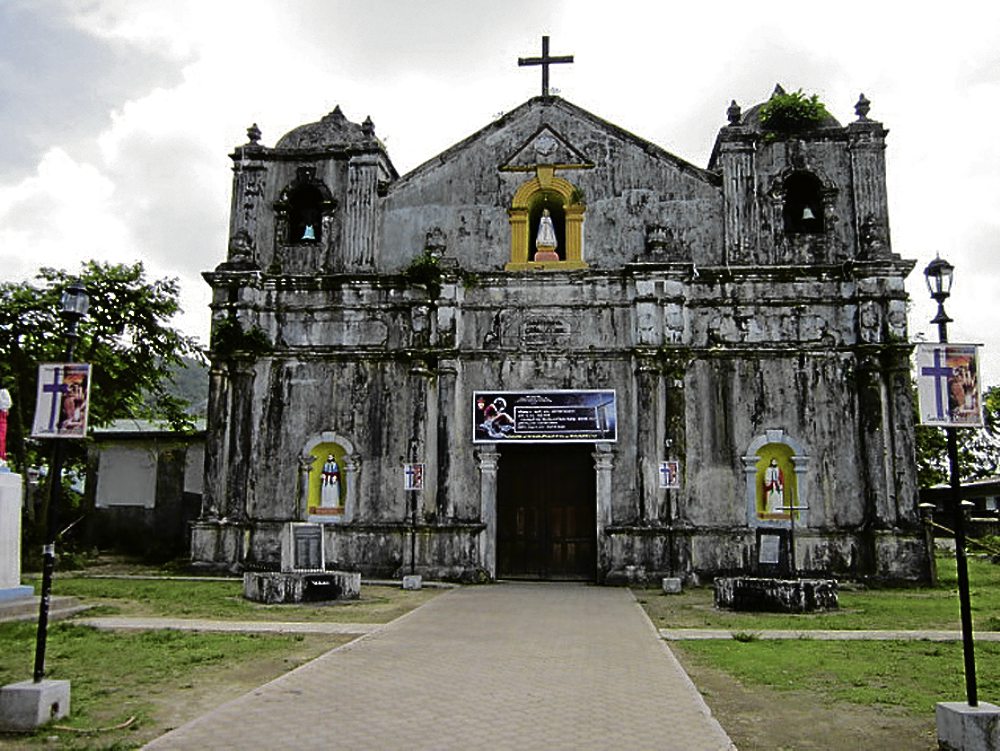
OUR LADY of the Candles Church in Paracale
For me, the climax of the tour was a visit (actually a revisit) to the lived-in, well-preserved and grand Rufino Pabico ancestral house, with its period fountain, capiz-shell windows, Art Nouveau designs, ventanillas, tertulia piano, old paintings, azotea and other reminders of a vanished era.
The owner, Francisco Timoner, 76, welcomed us again. His maternal grandfather Rufino Pabico had built the house in 1917 and he (Timoner) had inherited it from his mother.
I had been to this house 10 years ago, accompanied by cultural-travel PR Bernard Supetran. My article  (with photo) was published in the Inquirer’s Travel Section, then edited by Rosario A. Garcellano.
Now, to my pleasant surprise, I found that Timoner had framed and laminated that article and photo, on display in the living room. “After 10 years, you must write about my house again,” said Timoner, beaming.
I promised him I would do just that.

Thursday, June 16, 2011

Dr. Jose Rizal—the first Filipino TNT in America?


By Rodel Rodis

If U.S. immigration authorities were as strict in 1888, when Dr. Jose Rizal visited the US as a tourist, as they are now, the Philippine national hero—whose 150th birth anniversary we celebrate this week—could have faced deportation for an immigration violation.
When Dr. Rizal reached the port of San Francisco on April 28, 1888, after a 15 day journey from Yokohama on board the Belgic, he was placed in quarantine for six days, along with all the Asians on board, while Caucasians were allowed to freely disembark. This experience with racism had a profound impact on Rizal as he later described in a letter to Mariano Ponce in July of 1888:
“They placed us under quarantine, in spite of the clearance given by the American Consul, of not having had a single case of illness aboard, and of the telegram of the governor of Hong Kong declaring that port free from epidemic. We were quarantined because there were on board 800 Chinese and, as elections were being held in San Francisco, the government wanted to boast that it was taking strict measures against the Chinese to win votes and the people’s sympathy. We were informed of the quarantine verbally, without specific duration. However, on the same day of our arrival, they unloaded 700 bales of silk without fumigating them; the ship’s doctor went ashore; many customs employees and an American doctor from the hospital for cholera victims came on board.”
Rizal would not likely be a victim of racial profiling now as San Francisco and Oakland both have Chinese American mayors (Ed Lee and Jean Quan) while next door neighbor Daly City even has a Filipino American mayor (Mike Guingona). But Rizal might have been detained for a violation that could have made him the first Filipino TNT (slang for “illegal alien”) in America—he entered the US under an assumed name.
When Rizal was born on June 19, 1861 in Calamba, Laguna, his birth certificate showed his name as “Jose Protacio Mercado y Realonda”, the son of Francisco Mercado y Alejandro and Teodora Realonda y Quintos. That was the name he used until he enrolled at the Ateneo de Manila in 1872.
In 1872, the Spanish authorities cracked down on the secularization movement of native priests who were insisting on the right to preferential assignment in parishes over that of newly arrived Spanish friars. The leaders of this movement led by Fr. Jose Burgos were rounded up and executed by garrote. Rizal’s older brother, Paciano Mercado, was an associate of Fr. Burgos, and was also being hunted down. Fearing that family surname association with him would prevent Rizal from being accepted at the prestigious Ateneo, Paciano obtained a false birth certificate that allowed Jose Mercado y Realonda to enroll at the Ateneo as “Jose Protacio Rizal”.
“Rizal” was picked because it was the name (originally “Ricial” for “greenfields”), which his father adopted at one point until confusion in business transactions compelled him to return back to “Mercado” (Spanish for “market”), the surname his great grandfather, Domingo Lam Co, originally used after immigrating to the Philippines from Jinjiang, Quanzhou in the mid-17th century.
Changing surnames was not easy for the young Rizal who complained in a letter to a friend that the use of this assumed name was “giving me the appearance of an illegitimate child!” Ironically, after Rizal acquired notoriety as the author of Noli Mi Tangere (Touch Me Not) and El Filibusterismo (The Subversive), the entire Mercado family defiantly changed their surname to Rizal in 1891.
Despite entering the U.S. under an assumed name in 1888, Rizal had no problems with the authorities in the 10 days he spent traveling from San Francisco to New York City by transcontinental railroad. Along the way, Rizal passed through Sacramento, Reno, Ogden, Denver, Farmington, Salt Lake City, Provo, before going through Nebraska to Chicago on the way to Albany, New York, and then traveling along the bank of the Hudson River to Manhattan.
“I visited the largest cities of America with their big buildings, electric lights, and magnificent conceptions,” Rizal wrote Ponce in 1888. “Undoubtedly America is a great country, but it still has many defects. There is no real civil liberty. In some states, the Negro cannot marry a white woman, nor a Negress a white man. Because of their hatred for the Chinese, other Asiatics, like the Japanese, being confused with them, are likewise disliked by the ignorant Americans. The Customs are excessively strict. However, as they say rightly, America offers a home too for the poor who like to work.”
Little did Rizal know that less than just two decades later, from 1906 to 1925, more than 125,000 Filipinos would be brought to the US to work in the farm fields of Hawaii and California.
Rizal may have had a premonition of this future because two years after his US visit, Rizal wrote “The Philippines: A Century Hence” where he explained why none of the European powers as well as a China and Japan would be interested in colonizing the Philippines once Filipinos declared their independence. The only possible foreign power who may be interested in acquiring the Philippines? “Perhaps the great American Republic, whose interests lie in the Pacific,… may some day dream of foreign possession.”
In the course of his storied life, Rizal traveled the length and breadth of the United States, Europe and Asia but the Philippines always remained in his heart. As he reflected in a letter to Fray Pastells in 1895, “It is very possible that that there are causes better than those I have embraced, but my cause is good and that is enough for me. Other causes will undoubtedly bring more profit, more renown, more honors, more glories, but the bamboo, in growing on this soil, comes to sustain nipa huts and not the heavy weights of European edifices.”
Happy 150th birthday, Jose Protacio Mercado y Realonda, alias “Dr. Jose Rizal”.
(Send comments to Rodel50@aol.com or mail them to the Law Offices of Rodel Rodis at 2429 Ocean Avenue, San Francisco, CA 94127 or call 415.334.7800).