Showing posts with label tourism. Show all posts

Monday, October 29, 2012

Unraveling Masbate’s tourism treats


Unraveling Masbate’s tourism treats

October 29, 2012, 3:06pm
Buntod sandbar
Buntod sandbar
Filipinos may not know much about Masbate, but this province in the Bicol Region occupies a conspicuous space on the Philippine map – right at the heart of the archipelago.
Surrounded by the Burias and Ticao Pass on the North, the San Bernardino Strait on the East, the Visayan Seas on the South, and the Sibuyan Sea on the West, Masbate is blessed with bountiful marine resources, as well as stretches of beaches and coral reefs.
Composed of one city (Masbate City) and 20 municipalities, the province’s hilly landscape is also perfect pasture land for cattle and other livestock. In fact, Masbate is called the Cattle Capital of the Philippines because its ranches have been providing a huge part of the country’s cattle supply for several decades now. There are also coconut plantations all over the province as copra is a major source of livelihood for Masbateños.
Those who want to visit Masbate may conveniently book a flight with one of two domestic airlines that ply the route daily. Once in Masbate City’s airport, visitors will be amazed with how clear the skies are partly because of the absence of air pollution – no smoke-belching vehicles causing traffic and no industrial smokestacks spewing chemicals. Tourists will also be impressed by how clean Masbate’s coastlines are.
Ample accommodations near the airport can be found in Masbate City, most of which have a magnificent view of the Masbate Pass. Accommodations are also available in other beach resorts that dot neighboring municipalities.
A good way to start your itinerary is to experience the city’s pristine nature at the 21-hectare Pawa Mangrove Ecosystem and Wildlife Park, which is known for its 300-hectare dense natural mangroves and as a perfect site for bird watching, fishing and family picnic. It is also popular for its 1.3-kilometer boardwalk or wooden bridge that makes a trek to the park more enjoyable.
The 50-hectare Bugsayon Marine Sanctuary in Barangay B. Titong, Masbate City is also a must-see for ecotourists. One will see colorful and live corals and different fishes and other aquatic species upon snorkeling or scuba diving in Bugsayon. The reef was even ranked by the Department of Environment and Natural Resources (DENR) as the topmost resilient to climate change in Central Philippines.
Head to the pier and ride a motorboat to another marine sanctuary – the Buntod Reef Sanctuary that is made distinct by a 250-hectare white sandbar between the seawaters of Barangay Nursery and Barangay Tugbo also in Masbate City. You will marvel at its white sand, pristine waters, and rows of mangroves at the sandbar’s base. Dive deep into its unique hot and cold waters to see diverse marine life forms including hard and soft corals, coral breams, parrot fish, snappers, goat fish and, sometimes, green sea turtles.
Buntod is ranked second after Bugsayon as one of the most climate change resistant reefs in this side of the archipelago, making Masbate City a model place as far as preserving rich marine ecosystems is concerned.
Thriving marine ecosystems can also be found in Ticao Island and Monreal. There is also the Tacdogan Reef in the municipality of San Jacinto – one of only two areas where the manta rays abound. A 60-hectare shoal of rock formation, the area is where these mantas come to feed.
The province is also known for its countless white sand beaches that have remained uncrowded and unspoiled. It is indeed a wonder, if not a blessing, that tourists do not come here in droves.
Some of the province’s white sand beaches include the Sombrero Island and Tinalisayan beach in San Pascual, Burias Island, the Palani Beach in Balud, the San Isidro and the Puting-Baybay beaches in Claveria, the Aroroy and the Colara beaches in Aroroy, the Magcaraguit Beach in Dimasalang, the Alta Mar beach in San Jacinto, and the Halea beach in San Miguel Island, and Manokmanok Island in Esperanza. This place is not only Cattle Country, it is White Sand Beach country!
There are also the beautiful rock formations in Animasola Island in Claveria, the Lahong Cave in San Fernando, the Batuan Cave in Ticao, the Gato Cave in Aroroy, the Bat Ongan cave in Mandaon and the Lobster cave in Jamorawon Island. Rock formations that serve as natural diving boards can be found in Borobangcaso Island in Monreal, Balangingi in Pio V Corpuz,  Nagarao in Placer, and Talisay in San Fernando. There are also waterfalls in different locations within the province like the Catandayagan Falls in Danao, San Jacinto, the most beautiful in the province and the only one that falls directly to the sea.
A trip to Masbate also combines discovery with food tripping. Their sinigang has a unique ingredient called batuan that gives off a delicious sour taste. Bulalo ala Masbateño is also a must-try. And of course, seafoods and coconut-based fares are gastronomic superstars as well. The city’s native candy, the delectably sweet Carmelado candies, are made from carabao’s milk.
Your trip to Masbate will never be complete without visiting the cattle ranches in different parts of the province like in the municipalities of Balud and Milagros. The expanse of pasture lands that are commonly in hundreds of hectares to a thousand-or-so hectares are as far as your eyes can see. Some ranches like the Sese Brahmans Ranch in Balud will even teach you the basics of livestock handling including cracking the bullwhip and horseback riding.
The best way to end every trip is to visit the local church. You can have mass at the Masbate Cathedral where you will also see the adjacent Diocese-run school, the Liceo de Masbate. Every September, Liceo leads the celebration of the inter-school Galleon Festival.

Experience a luxurious and comfortable life + affordable rates and plans.
Masbate is the only province in the country that celebrates the Galleon Festival in honor of the Spaniards who brought Christianity into the Philippines. Note that historians have traced the start of the Christianization of the Bicol Region in Masbate when the Spaniards came in 1569. Noteworthy as well is the fact that, at the height of the Galleon Trade, the Mobo town of Masbate contributed premium lumber for the building of galleons, making it the center of trade in the province.
Other religious and thanksgiving festivals in the province include the the Himag-Ulaw Festival, the Pagdayao Festival, the Lapay Bantigue Dance Festival, the Kasadyaan sa Dagat festival and the Bantigue Feast;  proof that Masbateños have not only preserved their natural wonders, but have also upheld their religious traditions as well.
Who would have thought that the less talked about tourism offerings of Masbate could fill up one’s itinerary just like that, while still leaving numerous places that are waiting to be explored. So, next time you think of finding a place that will let you forget stressful city living, why not choose to discover the multi-faceted and overflowing natural and man-made wonders that await you in this beautiful province.

Friday, September 28, 2012

Tourism sector eyes bigger market


Tourism sector eyes bigger market


AS THE World Tourism Organization sees the Asia Pacific region as the next region to see in 10 to 20 years, local tourism stakeholders are aiming to get the Philippines on the large global tourism market.
Research, Education and Institutional Development (REID) Foundation vice president Cherrylyn Rodolfo, who presented to local stakeholders the state of Philippine tourism, said the country is ready to take advantage of this due to its strategic location in the Asia Pacific region and in Southeast Asia.
The Asia Pacific region has an annual tourism growth rate of 6.3 percent while Southeast Asian countries grew 6.8 percent.
She said that if the Philippines wants to catch up with its neighbors, it has to come up with new products to offer tourists. Rodolfo said the country had a “dismal performance” from 1980 to 2010.
They learned that it takes a visitor several years to realize his desire to travel to the Philippines. When they determined to find out why, she said there were indications that tourism suppliers had to turn guests away at certain times of the year due to a lack of capacity to accommodate them.
There is also a lack of products to lure them.
These, she said, were mostly during peak season.
Constraints
“So even if the Philippines was number one in their list, the visit was not realized because of the constraints they faced,” said Rodolfo.
Still, she believes the landscape of Philippine tourism is about to change, with the government completing its National Tourism Development Plan (NTDP) to come up with competitive tourism products, enhance connectivity and strengthen governance.
Rodolfo noted that in the product portfolio of the Philippines, which are sun and beach, culture, nature and cruise and nautical tourism, Cebu is able to offer all of these. “The question now is, do we want to part of that growth or are we content to watch at the sidelines?” she told those present.
Following the NTDP, she said some provinces have begun setting up their own tourism plan. Rodolfo said Cebu seems to have a major role for many of these provinces.
She explained that the Mactan-Cebu International Airport serves as a major gateway to many provinces and that the success of these destinations will also depend on how well the airport is positioned. She was glad to hear of the plans to expand it and added that the airport still has room for expansion so that it can serve other tourism development areas.
Rodolfo cited Bohol as a province that considers its linkage with Cebu as critical to their tourism plans and that there have been moves to work on tourism loops similar to what Hong Kong and Macau have. She said this can be explored by improving the ferry services and the port facilities and offering online bookings.
Competitors
Despite Cebu’s critical role in the development of other provinces, Rodolfo warned that even if they can be allies, these other provinces could also become competitors if Cebu does not work on its own tourism plan. Currently, there are plans to complete an international airport in Panglao, Bohol while other airports are also being improved. She added that Iloilo, which is the third busiest airport in the country, currently has no international flights. However, it will start its international flight to and from Hong Kong by November.
When in Cebu City, please visit gregmelep.com the new retirement paradise in the South.
Published in the Sun.Star Cebu newspaper on September 28, 2012.

Tuesday, August 14, 2012

Why Thailand has more tourists


I HAVE had the chance to go to Thailand on a number of occasions over a period of many years and most recently just a few days ago.  I could not help but wonder why it seems that they have more tourists than we do and just to be sure, I checked out the statistics. Yes, indeed. Thailand has a much more significant number of tourists than the Philippines.
Based on the statistics, there were 3.52 million tourist arrivals in the Philippines in 2010 and 3.9 million in 2011, posting a growth rate of 10.8 percent.  Thailand had 15.91 million tourist arrivals in 2010 and 18.89 million in 2011 for a growth rate of 18.73 percent.  Not only does Thailand have significantly more tourists than the Philippines, but they have also managed to grow at a much faster rate than we have, indicating that the tourism gap will get even much wider.
There must be a number of reasons why visitors prefer Thailand over the Philippines but I am certainly not in a position to tell you what all those reasons are.  However, there are a number of things that I noticed particularly in Bangkok that is quite different from Metro Manila which may cause this preference.  

One of the things I immediately noticed as I go inside any office building, department store, shopping mall or other facility, was that there were no security guards frisking you, checking on your bags and no vehicle trunk inspection.  This certainly is a much more pleasant experience than having to stand in line and have a stranger touch you. Of course, one might argue that the screening process you go through at airports is much more exhaustive, but then again, you really have no choice on the matter.
Perhaps, this constant unpleasant experience is taking its toll and tourists are voting with their wallets.  I noticed that other famous tourist destination spots like Hong Kong or Singapore also do not frisk or check people going into public places, much like in the US or other European countries.  Having myself frisked and my belongings checked all the time is not something that I like and I am sure other tourists feel the same way.  Tourists who come from the more developed countries probably think that this is an invasion of their privacy and may certainly be cause for worry that the Philippines is a riskier place that would necessitate these checks.
Seeing how the security guards do their rather superficial inspection, we should question how effective this really is.  Are we doing more harm than good by turning off tourists with all this checking and giving the negative impression about all these checks that we have to do this because if we didn’t, something bad will happen?  The government should make a study and look if all of these checkings are indeed effective and also see what is the number of violent incidents that occur in buildings in other countries where the practice of frisking and walking through metal detectors is not common practice.   How is it possible other countries are able to get away with all these inspections and yet there are no mass bombings and violence in all these places?
Another glaring difference that I noticed is the more efficient public transport system that they have that everyone including the tourists and other visitors use all the time.  Over here, the only real mass transport system we have is the LRT and the MRT, and even then they need to be drastically improved.  During rush hour, the line is so long that you literally have to stand in line outside of the station, sometimes even in the rain.  The routes and connections are also limited and very difficult for the use by most tourists.
In Bangkok, they have the overhead trains called the BTS and the underground trains called the MTR. They can handle the rush-hour traffic and even during off-peak times, you only need to wait for a few minutes to get a ride.  You can go to literally any place of interest in Bangkok using their mass transport system at a reasonable cost, in comfort and speed.  While the road traffic situation in Bangkok is not much better than in the Metro Manila, their mass transportation system is certainly much better in all aspects.
Let us start on working on these issues so that our tourists can truly say that it’s more fun in the Philippines.  Actually, it will also be more fun for us people living here.

Sunday, May 20, 2012


Family turns rest house into lucrative tourism site

By: 

share169 156

SANTOL room. PHOTO BY EV ESPIRITU/INQUIRER NORTHERN LUZON
BANI, Pangasinan—Tucked in the seaside village of Dacap Norte here, a compound where a family spends their vacation each summer is slowly being turned into a nature resort that harnesses the ecotourism potentials of this town.
The seven-hectare Old Woods by the Sea, which faces the West Philippine Sea, is still a work in progress, says Elizabeth Navarro, a retired doctor who, with husband Mayor Marcelo Navarro, owns and operates the resort.
But already, friends and guests are coming to enjoy what the countryside offers, she says.
Nature lovers will enjoy the resort’s pristine white sand beaches, coves, secluded sandbars, a 12-kilometer long cave, a waterfall, a mangrove forest and sanctuaries for fish and birds.

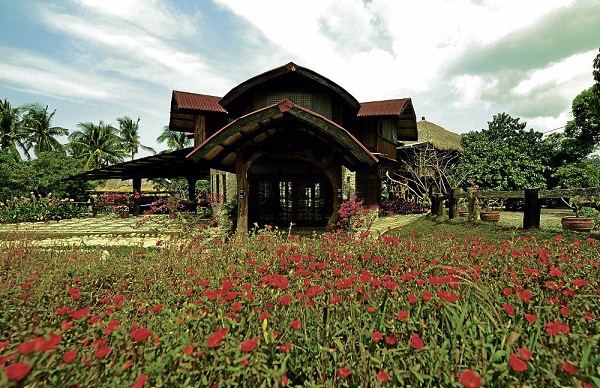
FLOWERS bloom at Old Woods by the Sea resort. PHOTO BY EV ESPIRITU/INQUIRER NORTHERN LUZON
“This was not intended to be a resort,” Marcelo says. “We built the original house in 1995 to be a retirement house for Daddy (his father and namesake, the late Mayor Marcelo Navarro Sr.), and as a summer place for family members.”
“[My father] loved to plant trees and he planted most of the trees here. But we lost him in 1997. The place was left untouched until 2001 when we repaired the house. I planned it to be my retirement home.”
The resort’s name, its owners say, may refer to the old trees around the compound and to the cottages built from wood salvaged from old buildings, churches and river beds.

TIMPUYOG, or gathering place, offers conference and workshop space at Old Woods. PHOTO BY EV ESPIRITU/INQUIRER NORTHERN LUZON
Seven cottages were built without damaging the natural elements in the area. For instance, if one finds a rock inside a room, it is because it was there before the cottage’s construction. If tree branches shade a porch, it is because these have not been trimmed.
The cottages have curious names. “Balay Bato” (stone house) came about because the deeper the workers dug when they were preparing its foundation, the more rocks and stones they excavated.
Balay Bato was supposed to be the “dirty kitchen” where firewood used for cooking would be stored. But the resort staff did not want to damage the structure so it was turned into a cottage instead.

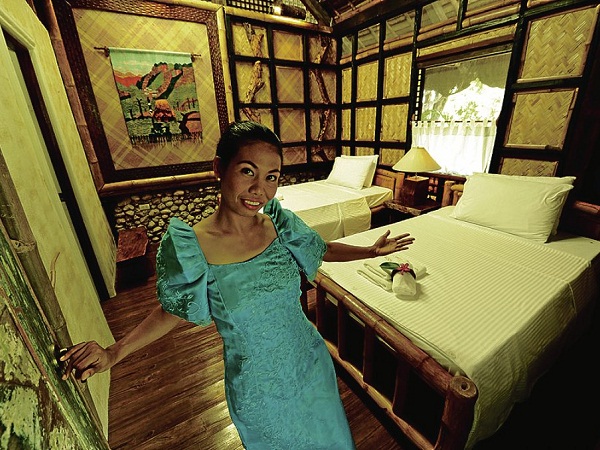
A BEDROOM at Old Woods by the Sea. PHOTO BY EV ESPIRITU/INQUIRER NORTHERN LUZON
Another cottage started out as a potting shed for Elizabeth, who loves gardening. When British birdwatchers advised local officials that they would visit the town, the shed was rebuilt to accommodate them.
The “Timpuyog” was where the mayor held meetings with his political supporters. It has been turned into a guest house with two bedrooms and a function area.
Some cottages were named after the trees near them—“Santol,” “Anahaw,” “Old Woods,” “Dayap,” and “Mangga.”
“Mangga cottage used to be called ‘Sineguelas’ (Spanish plum) as it was nearer that tree, but the wood carvers thought it was very long so we changed it to mangga instead,” Elizabeth says.
She says none of the cottages has air-conditioning because they want their guests to experience the natural environment. The resort is supplied by spring water.
Bani caters to the adventurous. There is a bike route to the pilgrimage area of Surip, or tourists can go kayaking, scuba diving or swimming. The beach is accessible through a trail that descends from the resort.

OLD Woods offers tours to the Bangrin mangrove forest in San Miguel, where migratory birds flock. PHOTO BY EV ESPIRITU/INQUIRER NORTHERN LUZON
Olanen cove and Tubong beach in Barangay Dacap Sur are alternative places for tourists to visit.
Guests can also explore the Nalsoc cave in Barangay Colayo. The cave system of Nalsoc (which means ‘big hole’ in Ilocano) boasts of stalactites and stalagmites.
Other nature treats for visitors in Bani are the Balingcawa falls in Ranao village and the Bangrin mangrove forest in San Miguel village.
The Bangrin mangrove forest is included in the 2008 book, “Bird Watching in the Philippines,” as one of the 13 best birdwatching sites in the country.
And to cap a tiring day around town, the Old Woods by the Sea offers hot meals and coffee at the Café Elizabeth, a cottage amid a sea of green.