By MA. GLAIZA LEE

The Big Lagoon in Miniloc Island (Photo by RUDY LIWANAG)
MANILA, Philippines -- How do you describe paradise?
To some, paradise is a state of the mind. It is the counter image of the miseries of the human civilization. It is about happiness, peace and contentment, but not necessarily about luxury and idleness.
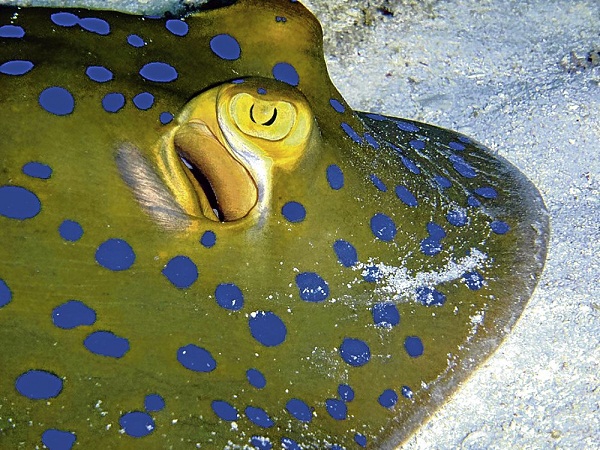
Others think that it is an actual place, a real place that resembles the Garden of Eden, or perhaps Utopia. It is about whale shark and sting ray swimming harmoniously with humans, without the worries that one will turn predator and the other will fall prey. Birds fly from tree to tree, unchallenged by rifles. Schools of fishes unafraid they will fall victims to dynamite and cyanide.
Paradise is something we all long for but can’t seem to be in. But there are things or places that give us a glimpse of what paradise could be, like Palawan.
Located on the western part of the Philippines, Palawan is an archipelago of 1,780 islands and islets.
While it has the biggest concentration of islands in the country, it is the most sparsely populated region. It is considered as the ‘Last Ecological Frontier of the Philippines” because it has scenic aquatic landscapes and high biodiversity.
History has it that the wildlife of Palawan originated from Borneo. About 20,000 years ago, the two places were interconnected by land bridges. Whenever the water level would rise, the animals, both aquatic and terrestrial, would cross over from Borneo to Palawan. But soon, when the land bridge collapsed and was no longer passable, some animals made Palawan their home and became endemic. Some of these animals include the Palawan bear cat, the stink badger, and the Palawan tree shrew.
In the northern part of the province alone, particularly El Nido and Taytay where the famous El Nido Resorts are located, one can see amazing centuries-old limestone cliffs that tower over marine sanctuaries with healthy marine ecosystem, teeming with innumerable species of tropical fish, vibrant coral species, and other aquatic entities.
Situated about 238 kilometers northwest of Puerto Princesa, the capital of Palawan, El Nido is bordered by the municipality of Taytay in the south, the Linapacan Strait in the north, the Sulu Sea in the east, and the South China Sea in the west.
Its name is derived from the edible nest (nido in Spanish) created by swiftlets (Scientific name: Collocalia fuciphaga) in the crevices of the limestone cliffs found in the 45 islands and islets that composed the town.
When traveling from the quite rustic airport in El Nido to Lagen Island Resort, one of the famous El Nido Resorts which is ideal for those seeking a relaxing holiday in a private and tranquil island, one can get a glimpse of the various islands in Bacuit Bay. Each island or islet has its own unique features. Take for instance the Cadlao Island. This island has the highest peak among the islands in Bacuit Bay, with the height of 609 meters.
Then, there’s the Dilumacad Island, also known locally as the Whale Island or Helicopter Island. It is called as such because it is shaped like a cooking ladle when viewed from the top, and/or a slumbering whale when viewed parallel from the sea. Most of the islands in Bacuit Bay are named because of their shapes or their characteristics.
Most of the islands in Bacuit Bay have secret coves with fine white sand beaches, perfect for sunbathing and picnic lunches. Within some of the El Nido islands are ancient caves with fascinating dripstone formations which are formed through weathering actions such as rain water trickling down their crevices and cavities million of years ago.
Arriving at Lagen Island Resort, one is greeted by the calm, shallow lagoon surrounded by a lush forest. The resort has 50 modern accommodations that exude subdued elegance. Each room has its own views. Some rooms have a magnificent view of the El Nido sunset, while the others have the surrounding forest and breathtaking limestone cliffs as their backdrops.
There’s a forest trail that one can traverse, leading to another cove with fine white-sand beach. The trail is a revelation in itself. It is so vibrant, as evidenced by the century-old trees that stand tall, erect, and proud.
Visit the Cudugnon Cave, and crawl through a small hole to enter the main cavern which leads to a smaller cavern believed by archeologists to be a burial site during the Neolithic period.
Not far away from Lagen is the Miniloc Island which is home to another must-visit resort, the Miniloc Island Resort which is also part of the El Nido Resorts.
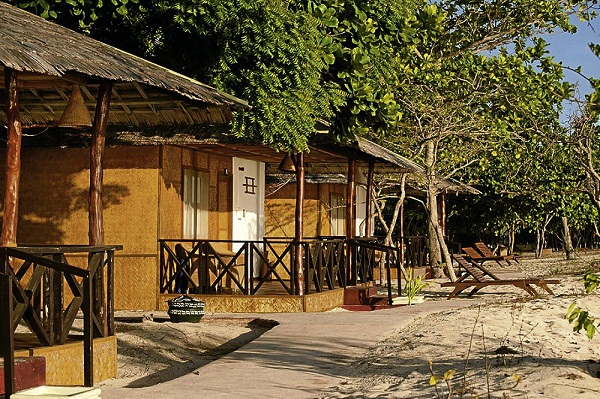
Tucked in a beautiful cove with a backdrop of sheer limestone cliffs, Miniloc Island Resort is reminiscent of a coastal village. The rooms in rustic and native design of the stilt houses stand over the crystal clear waters teeming with vibrant marine life. Here, guests don’t need to go far to snorkel. Just beside the docking area, they can swim alongside huge jacks, hundreds of sergeant majors, fusiliers, and other tropical fishes. If you’re lucky, you can even spot a dolphin or two, depending on the time and season.
Of course, they can also head to Mantinloc Island, the beautiful island (Mantinloc is a local term for beautiful), which boasts of two spectacular snorkeling sites, the Kalmung Point and the Kulasa Beach. It is also home to the Secret Beach; it is a secret because it can only be accessed by swimming into a small opening and through the rocks.
A few minutes away from the Miniloc Island is the Big Lagoon, which offers a scenic view of deep emerald waters, surrounded by limestone cliffs with a vibrant forest. It is said to be frequented by sea turtles. Not far away is the Small Lagoon, which is enclosed by towering marble walls. It can be reached only through a crack between the rocks. Beyond the rock coverings, one can see a crystal clear water pool that is perfect for swimming.
If that is not adventure enough, explore the caves such as the Cathedral Cave in Pinasil Island. It features a cathedral-like cavern within its confines. Or perhaps, head to Vigan Island. It is locally known as the Snake Island because it features a fine natural sandpit, an S-shaped sandbar, which looks like a snake swimming off the shore. But the sandpit only appears during low tide. From the beach front, one can take a five-minute trek to the top of the island to view the entire bay. Watch for pitcher plants, too!
From El Nido, one needs to take a boat to reach the town of Taytay, another tropical paradise located 220 kilometers northeast of Puerto Princesa, bounded by El Nido in the north, San Vicente and Dumaran in the south, Taytay Bay and Sulu Sea in the east, and South China Sea in the west.
Taytay, which means bridge in the local dialect, is the largest municipality in the province. Established as a Spanish town in 1623, it is considered the first capital of Palawan. The present day town enjoys a rich history and culture. Today, it is known as the gateway to northern Palawan.
At the heart of the town is a 17th century Spanish fortress, called Fuerza de Santa Isabel. It was built in1667 to protect the local inhabitants from the Moro pirates. There’s also the century-old Sta. Monica Church which was built when the first Spanish colonizers headed by the Augustinian Recollects came to Taytay in 1622. The church features thick walls made of solid limestone blocks.
Being a fishing village, the town is home to the biggest freshwater lake, Lake Manguao, in the province, and the Malampaya Sound which is dubbed as the “Fish Bowl of the Philippines.”
A huge Hollywood-like monument that spells the name of the town, built on a mountain overlooking the Taytay Bay can be seen from the sea port, where tourists can rent a boat to head to another El Nido Resorts, the Apulit Island Resort.
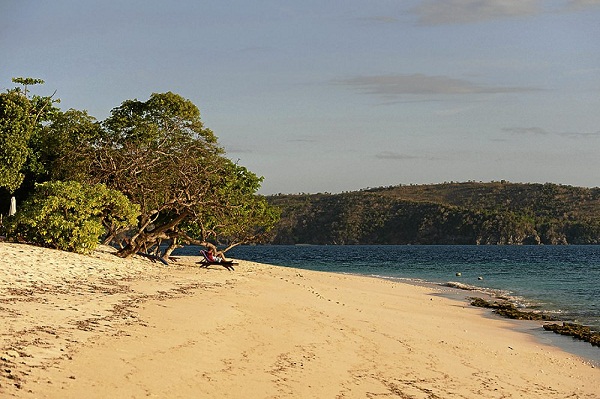
Apulit Island Resort is situated within a pristine cove with a wide expanse of white-sand beach lined with coconut trees. Its unspoiled location showcases a wealth of wildlife, colorful tropical fishes, and scenic landscapes. The sprawling resort has 50 stilt cottages, built in traditional architecture mixed with contemporary design.
While at Apulit, one can visit numerous caves which are situated just around the cliff. In one limestone cliff alone, one can see at least three caves situated beside each other. The first is the St. Joseph Cave. It is named after the formation that looks like St. Joseph. The biggest cave in Apulit Island, the cave has seven chambers with interesting rock formation. Another must-visit is the North Cave. One has to cross a small lagoon to reach the inner cavern. Sometimes, the cavern is used for private lunches and dinners.
There’s also the Lover’s Cave, which is a pair of coves located at the back of the Apulit Island. It is only accessible by swimming underwater and passing through an arch that leads to the cove. Taboito Cave, on the other hand, is characterized by a crack near the peak of the island. It is the refuge of the endangered Tabon bird or megapod, and the Balinsasayaw (swiftlet).
Around the island are several other equally beautiful islands such as Isla Blanca, a long coral white sandbar dotted with coconut trees, and Noa-noa Island, which boasts of a reef system as large as 12 hectares, the size of the entire island. Pabellon Island, composed of the Elephant and Castle Islands, and Nabat Island are often off-limits because it is the nesting area of the balinsasayaw, a source of edible nest which is often used to make nido soup.
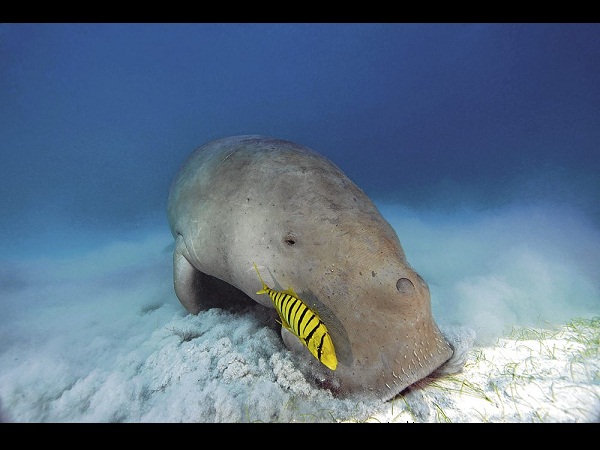
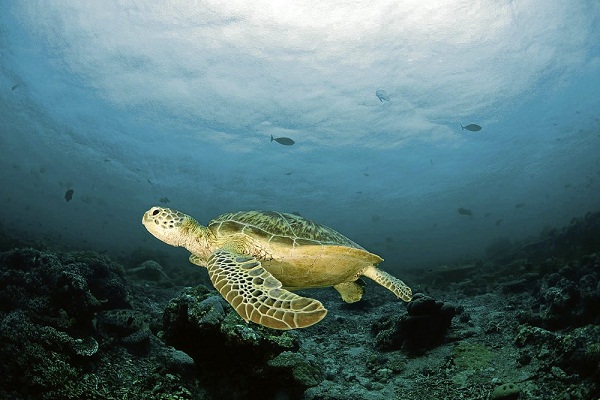
The El Nido-Taytay Managed Protected Area, one of the country’s richest marine reserves, showcases a spectacular geology and diverse wildlife. The waters of El Nido alone are home to 800 fish species and 400 coral species, much larger and diverse compared to that of the Caribbean which only has 50 species. Not to mention that El Nido is the nesting habitat for three species of endangered sea turtle, the Hawksbill, the Green Sea, and the Olive Ridley. There are at least eight varieties of sea grass that have been identified here, some of which are food for the dugongs (seacows).
In Taytay, there are more than 150 species of fish. There are also recorded sightings of whales, whale sharks, and manta rays. Three species of dolphin, which include bottle-nosed, Risso’s and Irrawaddy, are also identified here. The Irrawaddy dolphins can only be found in Malampaya Sound.
Being part of the “East Asian Flyway,” a major route used by aerial animals when they migrate from their homeland to their host feeding ground during winter, the forested areas around the marine sanctuary are home to more than 100 species of birds including the Grey Imperial Pigeon, Palawan Hornbill, Lesser Frigatebird, Eastern Reef Egret, and White-breasted Sea Eagle. It is also the habitat of several terrestrial animals such as Palawan Squirrel, Bising or White Squirrel, Monitor Lizard, Banded Mangrove Snake, and Long-tailed Macaque.
Operating in a rich marine ecosystem, the El Nido Resorts embrace a strong commitment to sustainability and exercise stewardship over the vibrant and diverse environment, stressing the importance of preserving nature for the future generations.
Dubbed as eco-resorts, El Nido Resorts offer nature-based guest activities and sustainable menus, and conduct environment education programs for staff and guests. They also believe in sustainable operation by providing employment opportunities for the local community.
To the uninitiated, paradise is simply Palawan.



 Posts
Posts

