Showing posts with label dumaguete. Show all posts

Friday, May 3, 2013

Dumaguete:Gateway to Negros Oriental


By Jacky Lynne A. Oiga
Published: April 21, 2013

Manjuyod White Sandbar
An eclectic mix of landscape, waters, historic landmarks, natural resources, culinary finds and the nicest, friendliest people - Dumaguete is a destination all its own. For all its diverse offerings, it’s a shame some Filipinos still can’t place it on the map.

Truth is, to the well-traveled, mostly well-heeled travelers, Dumaguete is a preferred, albeit low-key, destination. In fact, tourism in the City of Gentle People is far more robust than more popular neighboring destinations Bacolod and Iloilo. Yet people won’t see imposing billboards of touristic sites or kitschy tourist traps scattered in the city.

The laid back beauty of Dumaguete speaks for itself. It’s like a well-kept open secret and it seems like the Dumagueteños — as well as the hundreds of expats living in the city – want it to stay that way.

Located 641 kilometers south of Manila and the capital city of Negros Oriental, Dumaguete is primarily known as a university town because of the many educational institutions established in the area like the renowned Siliman University, Negros Oriental State University, Foundation University and St. Paul University Dumaguete.

As the main seaport and transportation hub of Negros Oriental, with easy ferry access from nearby provinces in Central Visayas, the city attracts a huge number of European, Japanese, Korean, as well as domestic tourists from all over the country.
Usually, visitors would start their itinerary with a city tour of Dumaguete passing through Siliman University, the iconic Rizal Boulevard and the Dumaguete Bell Tower, the oldest belfry in Negros Oriental.

According to locals, Dumaguete has some of the cheapest food fares in the country. In standard restaurants, a full meal with dessert can cost as low as P50.00. In hawker food stalls found around the city, P100.00 is enough to feed three people.

But of course, tourists should not leave Dumaguete without trying the city’s signature food offerings like Sans Rival (a cake made of layers of crunchy meringue, sandwiched with butter cream, topped with cashew nuts), Silvanas (a delicacy made of frozen buttercream sandwiched between two layers of cashew and meringue wafers), and tempura, a popular street food named after the deep-fried Japanese fare but is actually similar to the Chinese kikiam.

Dumaguete is also the gateway to nearby towns and islands of Negros Oriental that are dense with natural sites of interest and marine diversity. For dive enthusiasts, the city is just a quick boat ride to Apo Island and Sumilon Island, two of the Philippines’ most popular dive spots.

Beach lovers, on the other hand, can find a slice of paradise on the seven kilometer Manjuyod White Sand Bar, located in the town of Manjuyod. The sand bar is a two-hour drive from downtown Dumaguete. Stilt houses found on the sand bar are available for rent for tourists who want to stay the whole afternoon or spend the night. Boatmen also offer to temporarily anchor or park by the sandbar as guests swim, snorkel or laze around the sand.
Meanwhile, nature lovers can try an adventure hike to the Twin Lakes of Balinsasayao, tucked away in the hills of Sibulan. A good 45-minute drive from the city, the winding road will lead visitors to the extensive rainforest ecosystem that surrounds the twin lakes, Lake Balinsasayao and Lake Danao. The eco-parks cool mountain air is perfect for kayaking, horseback riding and trekking.

Other nature lover spots found in the Dumaguete countryside include: Mag-aso Falls, Red River Valley Falls and Red River Rick Hot Springs.
When it comes to accommodations, Dumaguete offers a slew of tourists’ inns, dive resorts, pension houses, boutique hotels and beach clubs – one of which is the recently re-opened Sta. Monica Beach Club located in Banilad, Dumaguete City.

Formerly owned by Japanese expats, Sta. Monica Beach Club used to be a run-down dive resort that caters to Japanese divers. Recently acquired by the Amorita group, the beach club now has a warm and cozy atmosphere, artisanal furnishings, a restaurant, deluxe rooms and beach houses, and amenities that cater to families, couples and companies.

“With the same level of exquisite customer service, we’re bringing the Amorita experience from Panglao Island to Dumaguete,” said Amorita Resorts managing director Nikki Cauton.

According to Sta. Monica Beach Club resort manager Cita Alcantara, even before Amorita acquisition, the beach club has been a popular wedding and events place for locals from Cebu, Bacolod and Dumaguete.

“But now that we renovated the place, more guests are staying for two to three nights to enjoy the pool and the spectacular view of the sea and the sunrise,” Alcantara said. “We can also arrange day tours for guests who want to explore the many sites of Dumaguete for minimum charge inclusive of transportation and personal butler service.”
To know more about Sta. Monica Beach Club visit www.stamonicabeachclub.com.


When in Cebu City, please visit http://www.gregmelep.com for your real estate and retirement needs. Avail of the opportunity to own a condominium unit in Cebu City at the low amount of only P 9,333.33 and House and Lot @ P 7,306.81/month only. Hurry while supply of units still last. Just call the Tel. Nos. shown herein: (053)555-84-64/09155734856/09173373687/09222737836.


Sunday, April 15, 2012

What lures ‘Yachties’ to stay happy in Negros bay


By 


share1096 1021

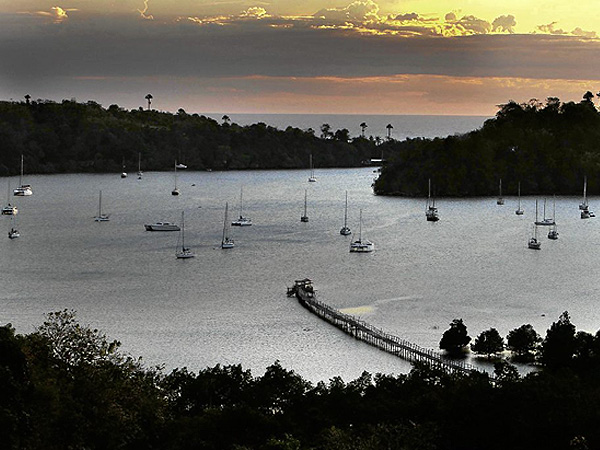
SLOW BOAT TO HAVEN. Boats from all over the world, of all shapes and sizes find refuge in Tambobo Bay in Siaton, Negros Oriental, backdropped by the majesty of mountains. Forested by extensive mangroves, the bay is one hour from the capital Dumaguete City. LYN RILLON
Siaton, Negros Oriental—Michael Prader, a retired artist from Austria, was travelling in Asia in search of the simple life when he heard about the Philippines where “even people in the villages speak English.”
His journey brought him to the Tambobo Bay, a beautiful cove in the quiet town of Siaton in Negros Oriental. With an extensive mangrove forest and a rich marine life, it is an ecological sanctuary situated at the southern end of Negros island, almost facing the Sulu Sea.
He totally fell in love with the place that he lost no time renting a bamboo house to start building his dream boat.
That was 10 years ago.
Now building a second sailboat, Michael, 60, is just one of the many foreign travelers who have found a safe haven in Tambobo and have chosen to live in boats moored in the bay’s still waters.
With the majestic Mt. Talinis and the Cuernos de Negros mountain range for backdrop, it is not surprising that many world travelers have found a home in Tambobo Bay. Schooners, sloops, catboats, sunfish (a type of sailboat), catamarans, ketches and yawls—name it, they can be found in Tambobo.
So comfortable and enchanting is the place that some sailors, finding the exotic girls of their dreams, have settled down and raised a family.
Cruisers are particularly attracted to the cove, an hour’s travel from the capital city of Dumaguete, because it shelters their boats from typhoons.
Tambobo has at least 30 boats at the bay.
Michael said he enjoyed living in the bay, where locals were also friendly and helpful.
Jobs for locals
He said foreigners got along well with the locals in Tambobo.
“Foreigners hire the local people who do not seem to have a chance to find jobs elsewhere,” he said, noting that they hire local carpenters in building or repairing their vessels.
Nemesio Avellano, who comes from Valencia, Negros Oriental, has decided to settle in Bonbonon because of the work opportunity. Although he specializes in building houses, he said the “Yachties,” as the foreigners are called, patiently guide him in boat building or repair.
The Yachties also tell the vendors what food they like to eat and how they want it cooked.
Business-minded
Arlene Palallos, owner of Arlene & Boy’s Café, was in her 20s when she paddled her small banca from yacht to yacht, selling bananas from a bilao (winnowing basket).
She became friends with her customers who went to her parents’ hut to be served guisadong munggo (sautéed mung beans). The Yachties then invited her to their boats for salads and sandwiches.
They asked if she could prepare meals, like in a restaurant, where they could come to buy food and drinks. They even told her how they wanted their bread made.
From her share in the sale of her mother’s property, Palallos bought a refrigerator and built a bamboo dock where foreigners could moor their dinghies and head straight into her little restaurant.
Giving from the heart
She also recalled her customers chipping in to pay for the surgery of her brother who figured in a motorbike accident.
“They also give financial advice; I know they want us to improve our lifestyle, and not only to eat once a day; they always give from their hearts,” she said.
The Yachties also reach out to the children through several learning programs.
American Diane Pool, 63, has initiated a Saturday school program called the One Candle Schoolhouse, where children learned writing, computer skills, the art of self-expression and life skills such as budgeting.
Now, it has evolved into Bright Lights Community Learning Initiative, a community-based, extracurricular school, with campuses in Bonbonon and in another barangay, Siit.
Couple aboard Pilar
Diane, a graphic artist-designer, and her husband Bill, a forensic geologist in the United States, arrived in Tambobo Bay in 2000 on board a 35-foot Atkins sailboat called “Pilar,” which was named after the heroine in Hemingway’s “For whom the Bell Tolls.”
It took them nine years to launch Pilar and seven more before they left San Francisco, California, in 1991 to see the world. Asked why it took them so long to build Pilar, they said it was because they put more importance to the process of building it together than just sailing it and reaching the goal.
In their sailing adventures, they were able to visit the remote islands of Mangareva, Caroline Island and Kapingamarangi, to name a few. It was while on the Solomon Islands that they learned about Tambobo from other cruisers.
“We were attracted to Tambobo immediately because there are not a lot of places in the world that are safe for boats; even expensive when there’s a marina,” Diane said.
“Here in Tambobo, we can leave our boats because it’s safe. This is not a tourist thing like in the Caribbean or Hawaii; we see Tambobo as our little paradise.”
It turned out to be an extended stay for them in Tambobo. They eventually acquired a small space along the shore which became a studio and workshop.
Like Michael, Diane said she and her husband were enjoying the simple life, including the sheer pleasure of having time to read a book.
One local even asked Diane how the Yachties live and if they have a table in their boat.
Life in a boat
Pilar has a two-cylinder engine, which runs an average of 24 hours on 27 gallons of fuel for 100 nautical miles at five knots. It has berths for four people to sleep on, a toilet and bath, a galley with a sink, an oven, a stove fueled by wood, and a canning machine, 90 gallons of water that could last her a month and a storage for everything.
They have a table but no refrigerator, electric fans, hot water or GPS. “Bill and I are dinosaurs,” Diane jested.
Upon their arrival in Tambobo in 2000, Diane offered to teach one child how to read on weekends. “Then many came,” and the One Candle Schoolhouse was born.
The couple taught the children to translate English storybooks into Cebuano or weave an original story based on a picture storybook.
Bill built a carpentry shop, and began teaching locals how to repair and build boats.
Budget lessons
At first, they had kids aged 5 to 15 years. They would take them to the market to teach them how to budget money; each would be given some amount to buy ingredients for a recipe they were going to cook.
They would also take the kids for a tour of Dumaguete. “We took them to the bookstore, an Internet cafe, an art show along the boulevard, and took them for a ride on the escalator at the local store.”
Other cruisers volunteered to teach the children sailing, pottery or painting or donate good-quality musical instruments.
Others would drive their motorbikes from their home in Dumaguete or Valencia to Tambobo twice a week to teach the children literature or computer applications like Photoshop and Excel.
“I feel good simply being with the local residents of Tambobo because I feel that we’re all connected, and that we can help each other to get better together,” Diane said. “Being in a community like Tambobo puts depth in my life.”
When Bill fell ill in 2009, Diane was at a loss. He passed away in the United States later, succumbing to cancer and leaving behind Diane, Pilar and the schoolhouse.
Diane decided to return to Tambobo because she knew the children needed her. She also missed basking in the beauty of nature from her sailboat. In her homeland, Diane said she felt more alone among thousands of people.
“But here in this small community of Tambobo—although I now live alone on the boat—there’s life starting in the early morning as you wake up to see neighbors sweeping their beachfront.”
Diane has continued the advocacy she and Bill started together. The learning center thrives through donors and with the help of friends who have either pledged support or volunteered time to teach the young and promising minds in Tambobo.
The centers have become a place of learning as well as a place for sharing and volunteerism.
Diane still lives on Pilar, keeping her hope of sailing her again. But for now, Tambobo is home.