Saturday, February 11, 2012

Memories of a once-virginal Boracay


By: 
rer
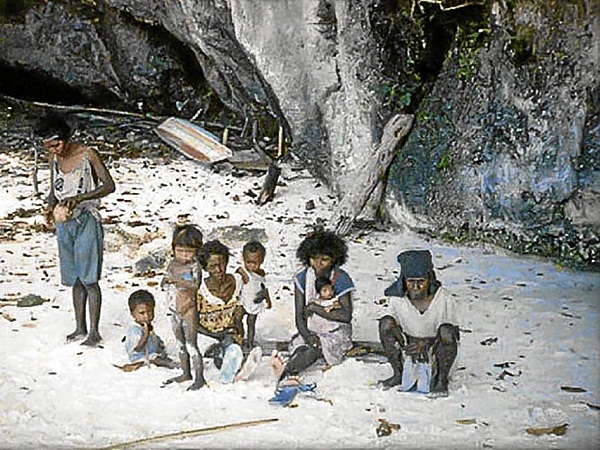
As my feet touched the Boracay sand, the aria of Grizabella from “Cats” started playing in my head as memories of old Boracay fill my weary mind. Am I getting old, or is there a new generation of tourists invading the island?
Why is it that every time I visit, I can’t stop comparing things with how it used to be? Don’t get me wrong; I would love to share the beauty of the island, but apparently the new generation of tourists seems to take things for granted. Is it me, or is this generation too brainwashed into thinking that everything is disposable?
I am not the only one who shares this sentiment. People who have previously experienced—take note I said experienced, not visited—the island feel the same way. I would pick up comments from people in the next table or cabana, about how different the place has become, from the kind of tourists visiting, to the mushrooming cement edifices that are becoming eyesores.
Some say it’s progress, some say it’s luxury. Since they haven’t experienced the old Boracay, others don’t care much.
Then it hit me. I would do a social experiment on the island. I would not only explain and describe the old Boracay, but I would let three people experience the island the way I experienced it.
I found a gorgeous Brazilian couple who found the idea interesting, a local Filipino industrial designer who is a first-timer on the island, and a balikbayan who last visited the island 13 years ago. And just to add spice to the fray, I invited direk Joey Reyes to contribute his two cents’ worth.
Beautiful sunset
The island is famous for its beauty, and what better to symbolize a beautiful island than a beautiful sunset on the beach? I invited everyone to happy hour on the beach, as the skies start turning orange and pink. Add music and sexy bodies prowling the shore, and the result is hypnotic. They all agreed that this is the life. I paid for the drinks, of course, and God provided the sunset.
Next day I asked all of them to walk with me beyond Station 3, past the market, past all the roads, in the direction of Asya Hotel. We stopped by a simple hut that had a huge hammock hanging by a coconut tree and ordered drinks. I asked them to take off their flip flops and feel the sand. It was finer and cleaner, cooler even.
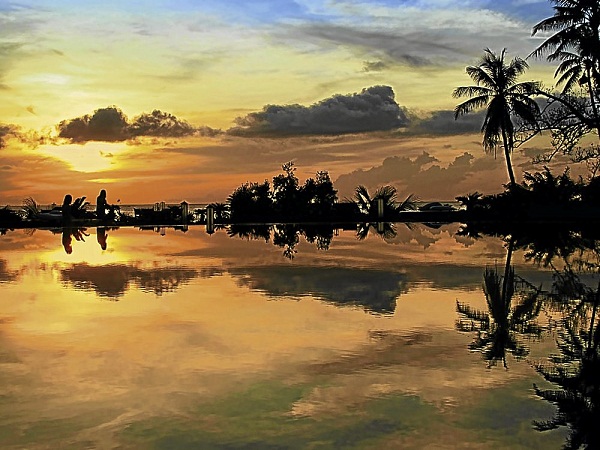
Their ears felt different. No music blaring from huge speakers. Then God did it again; this time a burst of orange filled the horizon as pink clouds swirled in the vast blue sky. My guests were quiet; no one spoke as the last hint of light was extinguished in the blue water beyond.
I needed to sigh, because the silence was deafening. That’s when someone asked, “What happened?” I didn’t answer. They all felt sad that the music in all the establishments in Station 2 had drowned out the sound of the waves and the rustling of the trees in the wind. I told them this was Boracay when I first experienced it. Calm, serene, as it should be. We all walked home silent and pondering.
The next day I asked everyone how their accomodations were, and all of them answered that it was fine. Following the same route we did the day before, we walked once again towards Asya.
This time I led them to Angol Resort, an ecotourist resort where they minimize the use of electricity and anything that may harm the planet. Five steps into the resort, we could already hear the birds chirping and dragonflies buzzing. We entered a nipa cottage complete with a hammock and daybed that was bathed in the orange glow of the sun. We sat by the patio and drank coconut juice in the shell which our host served.
Commerce and strangers
Again, the first question was, why? Why did this kind of huts disappear, and why were they replaced with cement? The island lost its personality. I recounted to my guests that before, the island had the romantic allure of a secluded virginal island where fantasies came true. Now it has become a crowded island of commerce and strangers.
Gone are the days when you could walk the island, and people would greet you and smile. If you do that now, you get strange stares and might be accused of solicitation, which is not that far-fetched in the present situation. You hear voices in the dark offering a massage, and if you don’t reply, the next offer will be for oral sex.
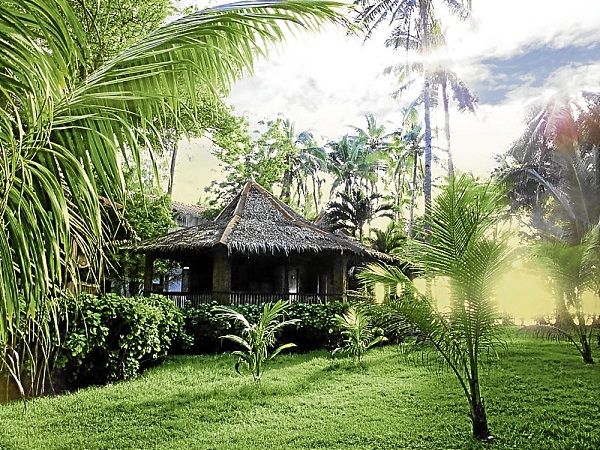
My guests all wondered why we Filipinos love imitating other cultures when our country is full of interesting things. The mere fact that we don’t like nipa huts makes them wonder. I told them that the whole island used to be lined with nipa huts of different kinds and sizes, as accommodation for tourists.
Now, you can count on the fingers of one hand which ones have survived. Even nipa cabanas along the beach have been replaced by the modern umbrellas you see in catalogues.
Interestingly enough, the Vancouver guest compared his visit now with his last visit 13 years before. “Boracay has progressed as a developing tourist industry, but has regressed as a virgin island,” he said. One guest even joked that the island is so crowded, it just might sink.
We all met for dinner later with Joey Reyes as our special guest. Joey’s spontaneous manner and unparalleled humor kept us laughing for hours. He too shared his Boracay point of view and its current evolution.
Some of my guests felt thankful that they experienced more. The others felt sad for experiencing what could have been, and the rest just surrendered to that fact that Boracay might be dying a slow death. And to end the whole debate, Joey raised his glass for a toast, exclaiming, “To the virginal island of Boracay; it’s as virginal as a 60-year-old whore who yearns to retire as a mama san.”

Tuesday, February 7, 2012

Amazing Sablayan


Apo Reef aerial shot
MANILA, Philippines — The resort town of Sablayan in Occidental Mindoro unveils its fun side as it celebrates its 110th founding day and Dugoy Festival this month of January.
 Situated on the western coast of the biodiversity-rich Mindoro island, the town takes pride in Apo Reef Natural Park, a Unesco World Heritage Site and the second largest contiguous atoll-like reef coral reef in the world.
 A center for marine biodiversity, Apo Reef has a high diversity of corals and marine life, and has an island covered with terrestrial vegetation.
According to Sablayan Mayor Eduardo Gadiano, the fun has already begun with various sporting tournaments, socio-civic activities, entertainment and cultural events.
He said that the celebration will highlight the town’s amazing ecotourism hideaways which can rival even the more established destinations.
 A few minutes away from the town is Pandan Island, a palm-lined white beach island and unspoilt forest. One can explore the island’s forest and gaze at the colorful species of birds before splashing in the waters of “Wild Lagoon”.
Outdoor lovers can trek Mindoro Pines, dubbed as Mindoro’s “Little Baguio” which sits atop the Pag-asa Mountains, the habitat of Mindoro endemic pine tree specie, pinus mercussi. Located at the heart of Mangyan ancestral lands, immersion with the ethnic communities is a unique cultural experience.
 There’s also Mts. Iglit-Baco National Park, which is also an ASEAN Heritage Park with multi-strata evergreen forests and habitat of the biggest remaining population of tamaraw, the country’s national animal. It has an aggregate area of 106,600 hectares, with more than half of it lying within Sablayan.
 Conservationists can lose themselves at Siburan Forest, which boasts of 5,000 hectares of primary forest, the largest tract of its kind in Mindoro. It is sanctuary to 31 kinds of birds, among them the endemic Mindoro imperial pigeon, Mindoro tarictic hornbill, Mindoro bleeding heart, scops-owl and the black-hooded coucal, more than eight mammal species mammals, like pygmy fruit bat and warty pig and some 80 tropical plants and hardwood species.
Near the base of the forest is Libuao Lake, where one can bask fishing, bird watching, picnicking and boating in one of the country’s cleanest inland bodies of water.
Another nature escape is the 20-foot Malatongtong Falls whose scenic verdant forest backdrop rushes into a natural crystal clear pool towards smaller cascades flowing into the river.
 Back in the heart of the town are the Parola Park and the 16th-century old Spanish church which attest to Sablayan’s historicity, as well as a Golden Gate-inspired hanging bridge. The public plaza, also known as Presing Park, is punctuated by a watchtower and a circa 1860 cannon built against Muslim raiders and intruders from the sea.
 For a taste of local heritage, take a peek at Sablayan Museum, the only one of its kind in the province, which showcases the town’s character. A unique feature is the “nature” section which simulates the town’s forest and underwater world.
 Gadiano said festivities conclude with the Dugoy Festival on Jan. 27 to mark the town’s founding day in 1902 under the American Civil Government. The event’s highlight is a street presentation which pays tribute to the Mangyan tribes of the town, the indigenous inhabitants of Mindoro.
 He noted that even after celebrations had died down, the fun goes on for the rest of the year with its natural wonders. Log on to www.sablayan.net on how to enjoy the fun in amazing Sablayan
.

Monday, February 6, 2012


Inampulungan: Hidden Treasure Of Guimaras

My World in a Flashpack
By EMMIE V. ABADILLA

Above: Beach Us-Usan Island; Right: Costa Aguada Beach
MANILA, Philippines — Over the shimmering emerald expanse of Panay Gulf, Inampulugan, “Mother of All Islands”, uncoiled like a crocodile lugging three mountains on her back.
It was the biggest chunk broken off Guimaras, the Mango Country, tucked away to the Southeast of Iloilo City, amidst fishing grounds that yielded blue crabs for Japanese tables, squids, stingrays and groupers for the locals. Its mountains nurtured virgin forests. Bamboo, coconut and mangroves flourished on its sugar-white coasts.
My destination actually nestled between Inampulugan’s beaches and mountains, the 1,067 hectare Costa Aguada Island Resort. It was almost dusk when I got there after seven hours of travel by land, sea and air.
While there was light, I padded along the beach. Tiny tunnels pockmarked the white expanse, each with sand piled neatly to one side. I went down on my knees to play hide and seek with pale sand crabs.
When I straightened up, I startled a group of herons. They flapped up a higher perch among the bleached skeletons of half-submerged trees.
To the west stretched a forest of centuries-old gnarled mangroves that transforms itself to a sunken wilderness with each incoming tide.  On its end stood a 5,000 square meter stone fortress – the holding pen of almost half a hundred endangered, two-year-old hawksbill turtles.
I walked on until I ran out of coral beaches and blundered in the midst of whispering bamboos. It felt like intruding in an enchanted throng in conference. In the windless, deepening darkness, I watched the bunched trunks nod and creak.
Up ahead, the mountain beckoned to me. I don’t have the luxury of much time, however. So, I asked the resort manager’s permission to do a night trek in the jungle.
A local told me they used to have tamaraws (wild buffalo) here once, but Costa Aguada’s owner had the beasts captured and relocated when they started goring islanders.
Native brown deer still dwell in the jungles. Monkeys feed on coconuts and wild fruits. Rare birds breed in the mangroves and marshes.
Reluctantly, the manager gave in to my wish, provided I bring along one security guard with a shotgun and a local familiar with the terrain.
Already, they had enough mishaps in full daylight. A male guest got lost for 24 hours and a foreign lady slipped and fell down the mountain path. Worse, folks feared malevolent spirits killed a couple of the resort’s security guards in their sleep.
In Costa Aguada’s history, no one dared wander through the mountain after dark. But I didn’t know that when I began climbing behind the resort before midnight.
I scrambled over a steep path, past upturned boulders and fallen trees, seeking footholds on scree blanketed with leaves. Frogs, birds and cicadas scolded me as I bulldozed my way.
At the forest canopy, a young white-breasted sea eagle roused on his roost. My head lamp caught the coppery gleam of a python wrapped tight in the lower branches. Further ahead, a pregnant doe stood transfixed as I shone my light in her eyes. She bounded away when I advanced.
Yet, for the most part, the forest was silent. At the peak, I gazed out into the blackened expanse of the Panay Gulf lit only in places where fishermen’s boats plied its surface. A shooting star flashed and vanished. I gawked at the night sky, one of the clearest I ever saw.
I should have bivouacked in this forest, I thought. It was much cooler here than in my cottage. I could make myself a bed of twigs under a rock ledge or lie down beneath this breathtaking canopy.
But it was getting closer to dawn now and my escorts need their sleep. On the way down, I came upon a tunnel gouged out of the rocks – a cave where the Japanese hid during the last World War. Only bats and snakes live there now. I was curious and would have explored its depths if my escorts had not dissuaded me.
We skirted past cracked coconuts, leftovers of monkeys who fed on the path, and wound up in the turtle park. The tide had ebbed, exposing the occupants of the enclosure, along with clumps of sea urchins bristling with foot-long spines.
Warily, my security guard escort shone his flashlight on the edges of the cove. Sometimes, poachers would sneak in during these wee hours.
Back in my room, I had barely closed my eyes when they summoned me for breakfast.
We set out for neighboring Nauway Island, home to some 200 fisher folk who supply seafood to the resort. The boats in the island seem to outnumber the huts. Mangy dogs, mostly skin and bones, fled from our path. Sunburnt children ogled at us though the men mending their nets barely gave us a glance.
Others are busy lashing baited crab creels on bamboo platforms, ready to set out to sea. A 74-year-old villager still works his nets daily although one daughter is a teacher in Manila and another works as a bank manager in the U.S.
The island has an elementary school but no hospital or doctors. A midwife visits them weekly but in case of an emergency, they have to transport their sick to Pulupandan, 45-minutes sailing by banca.
I trotted after the Costa Aguada staff as they went from house to house, asking what the fishermen are selling for the day. Here, they had formed a cooperative but no official market. A representative of a Japanese buyer monitors the catch and the shipment. Because the islanders have no cold storage, they ship their blue crab harvest straight to the Pulupandan plant which processes the meat to flakes for export to Japan.
Yet I was saddened to see fisher folks tossing crabs bursting with eggs into the trays of rejects. They should have automatically returned the gravid females to the sea.
In another house, a woman waved us over to two ice boxes crammed with eagle rays. Our boatman hoisted up an almost 50-pound eagle ray so the photographers can snap some shots.
I seek out eagle rays during my dives. Once, I had fed shellfish to a giant ray who took my whole hand in his bone-crushing mouth. Now, I touched the edges of the ray’s wings, slimy and cold in death, his pure white underside gashed and bloodied.
Unfortunately, the fishermen are beginning to feel the pinch of the ocean’s depleting resources. Each year, they are hauling in progressively smaller catches, they admitted.
The day’s marketing over, we sailed off to Us-usan Island for lunch. In the dialect, us-us means to “slide” because its sand bridge literally “slides” into different shapes, depending on the season.
Us-usan’s caretaker, an 88-year- old war veteran, watched us from under the shade of a coconut tree as we docked. The beach on the leeward side of the island is ideal for swimming. But my sleep debt was catching up with me.
I dozed in the shade before a lunch of grilled pork, prawns, crabs, grouper, stingray in coconut milk and rice wrapped in banana leaves.
Afterwards, we sailed back to Inampulungan for the island tour of Liog-Liog village, 2.5 kilometers from Costa Aguada.
I drove by Bamboo Beach, the school, the only spring of fresh water in the island and the coop house crammed with hand-crafted coconut shell cups, chimes, back scratchers, bamboo ladles, hand-woven baskets, coco soaps and coco vinegar.
On to the other side of the island, we passed The Rock, a hill of solid stone, and inspected the World War II Japanese Bunker – a lookout which the soldiers used to see all the ships and enemy tankers passing through Guimaras Strait.
Returning to the resort, we drove by the mini zoo, which holds African guinea fowls, a jungle rooster or labuyo caged with a couple of fat chickens and a number of bunnies who have tunnelled through the entire earthen floor of their cage. The zoo used to keep a python until the constrictor squeezed through the chicken coop and devoured the occupants.
A juvenile sea eagle, whose cage mate has escaped, blinked at me from his perch. A black wild cat dozed in the neighboring enclosure. His mate has also pulled a Huodini act on her keepers and fled into the mountains.
At the end of the tour, I visited the turtles once more. A three-flippered sub-adult swam alongside me as I trotted on the top of his rock wall, hoping for hand-outs. When I stopped, he stopped. When I resumed walking, he followed. At one point, he attempted to clamber over the barrier to join me.
By twilight, I was back in my room. The daughter of a local hilot kneaded my aching muscles. A teacher at the village school, also moonlighting as a masseuse, gave me a spa using cold coconut milk.
Outside, the voice of the sea lulled me. The bamboo forest whispered sleep. And willingly, I surrendered

Sunday, February 5, 2012

Lanao Del Norte: Beyond Motocross


By ROBBIE PANGILINAN

Maria Cristina Falls (www.conchparadise.com)
MANILA, Philippines — There is much more to Lanao del Norte than just being the Motocross Capital of the Philippines.
True, it prides itself in being the prime location for the extreme sport, with its world-class and expansive dirt track at the Mindanao Civic Center (MCC). Viewers are able to watch every twist, turn and crash of the racers from the comfortable vantage point of the spacious grandstand in front of the dirt track.
Lanao del Norte hosted the first-ever international motocross event in the country in December 2010. Being a rider himself, Lanao del Norte Governor Mohamad Khalid Q. Dimaporo (a third generation governor from the traditional political leaders of the province, the Quibranza and Dimaporo families) included motocross as one of the highlights in the Araw ng Lanao del Norte celebrations. SEL-J Sports, the prime advocate for the rehabilitation of motocross in the Philippines, conducts its motocross races here.
But, that is not all there is to Lanao del Norte. A website description reads: “From its many majestic waterfalls, relaxing coastlines to rugged plateaus and verdant mountains rich in flora and fauna, the province of Lanao del Norte pulsates with electrifying cultural diversity of gentle and proud people – one of the many windows into the soul of the often misunderstood Mindanao.”
The famous Maria Cristina falls is located in Iligan City. Nicknamed the City of Majestic Waterfalls, Iligan has over 20 waterfalls. Maria Cristina is 320 feet high and spills 130 cubic meters per second of water which provides electricity. Near the majestic falls is the Macapagal-Macaraeg Ancestral House where former President Gloria Macapagal-Arroyo spent part of her childhood. Another popular falls is the Tinago Falls with its curtain-cascade falling into a basin of cold water. It is accessible only through a 300-step staircase, hence its name tinago or hidden.
Many kilometers away from the city proper are Hindang Falls with its cave clusters, and Limunsudan Falls which is the second tallest falls in the Philippines at 870 feet. A two-day trek is required to reach the waterfalls. Other beautiful waterfalls in Lanao del Norte are the Mimbalut Falls, Abaga Falls, Dodiongan Falls, Pasayanon Falls, Munai Falls and the Fairy Falls.
Besides its famous waterfalls, the province also has springs with crystal-clear waters that flow into resort swimming pools like the Timoga Springs. Cold and pure spring waters flow from Kalilangan to the Pili Hot and Cold Springs, Cabongbongan and Inasagan Spring, Kawa-kawa Spring and the Pioray and Babuyan Lake. Lanao del Norte also has the Lidpa Subterranean River in Munai and simple beaches in Linamon.
Those who are not water-lovers can climb Lanao del Norte’s 1,600-feet Mount Agad-Agad, which is the highest peak in Iligan City and is safe for mountain climbing, camping and trekking. Mount Inayawan, on the other hand, has a rainforest with rich biodiversity.
Filipinos love festivals, and in Lanao del Norte, festivals abound.  Visitors and locals alike take part in the Araw ng Lanao del Norte Celebration (Lanao del Norte Day) which coincides with the Sagayan Festival, Hudyaka Festival which is a thanksgiving celebration, the Saguingan Festival, the Guini-akan Festival, Niyogan Festival, Alimango Festival and the Coconut Festival.
Lanao del Norte enjoys great weather the whole year so any time is a good time to visit. Don’t forget to try their delectable dishes like durian shake and fresh crabs and shrimps from Panguil Bay. Lechon and barbecue stands are everywhere. Cheding’s peanuts are a trademark Iligan pasalubong.
Amidst its simplicity, Lanao del Norte also has night spots where the younger ones can enjoy clubbing, dining or just chilling out with peers.
The province is a major contributor to the progress of Mindanao. It is home to three of the seven Agus Hydropower Plants that generate 80 percent of Mindanao’s power. Lanao del Norte is the second largest producer of copra in the region with its more than 70,000 hectares of coconut land.
So, when in Lanao del Norte, take an extreme ride, then fall in love with its beautiful spots and rich culture

When in Cebu City, please visit gregmelep.com for your real estate and retirement needs.
.

Inampulungan: Hidden Treasure Of Guimaras


My World in a Flashpack
By EMMIE V. ABADILLA

Above: Beach Us-Usan Island; Right: Costa Aguada Beach
MANILA, Philippines — Over the shimmering emerald expanse of Panay Gulf, Inampulugan, “Mother of All Islands”, uncoiled like a crocodile lugging three mountains on her back.
It was the biggest chunk broken off Guimaras, the Mango Country, tucked away to the Southeast of Iloilo City, amidst fishing grounds that yielded blue crabs for Japanese tables, squids, stingrays and groupers for the locals. Its mountains nurtured virgin forests. Bamboo, coconut and mangroves flourished on its sugar-white coasts.
My destination actually nestled between Inampulugan’s beaches and mountains, the 1,067 hectare Costa Aguada Island Resort. It was almost dusk when I got there after seven hours of travel by land, sea and air.
While there was light, I padded along the beach. Tiny tunnels pockmarked the white expanse, each with sand piled neatly to one side. I went down on my knees to play hide and seek with pale sand crabs.
When I straightened up, I startled a group of herons. They flapped up a higher perch among the bleached skeletons of half-submerged trees.
To the west stretched a forest of centuries-old gnarled mangroves that transforms itself to a sunken wilderness with each incoming tide.  On its end stood a 5,000 square meter stone fortress – the holding pen of almost half a hundred endangered, two-year-old hawksbill turtles.
I walked on until I ran out of coral beaches and blundered in the midst of whispering bamboos. It felt like intruding in an enchanted throng in conference. In the windless, deepening darkness, I watched the bunched trunks nod and creak.
Up ahead, the mountain beckoned to me. I don’t have the luxury of much time, however. So, I asked the resort manager’s permission to do a night trek in the jungle.
A local told me they used to have tamaraws (wild buffalo) here once, but Costa Aguada’s owner had the beasts captured and relocated when they started goring islanders.
Native brown deer still dwell in the jungles. Monkeys feed on coconuts and wild fruits. Rare birds breed in the mangroves and marshes.
Reluctantly, the manager gave in to my wish, provided I bring along one security guard with a shotgun and a local familiar with the terrain.
Already, they had enough mishaps in full daylight. A male guest got lost for 24 hours and a foreign lady slipped and fell down the mountain path. Worse, folks feared malevolent spirits killed a couple of the resort’s security guards in their sleep.
In Costa Aguada’s history, no one dared wander through the mountain after dark. But I didn’t know that when I began climbing behind the resort before midnight.
I scrambled over a steep path, past upturned boulders and fallen trees, seeking footholds on scree blanketed with leaves. Frogs, birds and cicadas scolded me as I bulldozed my way.
At the forest canopy, a young white-breasted sea eagle roused on his roost. My head lamp caught the coppery gleam of a python wrapped tight in the lower branches. Further ahead, a pregnant doe stood transfixed as I shone my light in her eyes. She bounded away when I advanced.
Yet, for the most part, the forest was silent. At the peak, I gazed out into the blackened expanse of the Panay Gulf lit only in places where fishermen’s boats plied its surface. A shooting star flashed and vanished. I gawked at the night sky, one of the clearest I ever saw.
I should have bivouacked in this forest, I thought. It was much cooler here than in my cottage. I could make myself a bed of twigs under a rock ledge or lie down beneath this breathtaking canopy.
But it was getting closer to dawn now and my escorts need their sleep. On the way down, I came upon a tunnel gouged out of the rocks – a cave where the Japanese hid during the last World War. Only bats and snakes live there now. I was curious and would have explored its depths if my escorts had not dissuaded me.
We skirted past cracked coconuts, leftovers of monkeys who fed on the path, and wound up in the turtle park. The tide had ebbed, exposing the occupants of the enclosure, along with clumps of sea urchins bristling with foot-long spines.
Warily, my security guard escort shone his flashlight on the edges of the cove. Sometimes, poachers would sneak in during these wee hours.
Back in my room, I had barely closed my eyes when they summoned me for breakfast.
We set out for neighboring Nauway Island, home to some 200 fisher folk who supply seafood to the resort. The boats in the island seem to outnumber the huts. Mangy dogs, mostly skin and bones, fled from our path. Sunburnt children ogled at us though the men mending their nets barely gave us a glance.
Others are busy lashing baited crab creels on bamboo platforms, ready to set out to sea. A 74-year-old villager still works his nets daily although one daughter is a teacher in Manila and another works as a bank manager in the U.S.
The island has an elementary school but no hospital or doctors. A midwife visits them weekly but in case of an emergency, they have to transport their sick to Pulupandan, 45-minutes sailing by banca.
I trotted after the Costa Aguada staff as they went from house to house, asking what the fishermen are selling for the day. Here, they had formed a cooperative but no official market. A representative of a Japanese buyer monitors the catch and the shipment. Because the islanders have no cold storage, they ship their blue crab harvest straight to the Pulupandan plant which processes the meat to flakes for export to Japan.
Yet I was saddened to see fisher folks tossing crabs bursting with eggs into the trays of rejects. They should have automatically returned the gravid females to the sea.
In another house, a woman waved us over to two ice boxes crammed with eagle rays. Our boatman hoisted up an almost 50-pound eagle ray so the photographers can snap some shots.
I seek out eagle rays during my dives. Once, I had fed shellfish to a giant ray who took my whole hand in his bone-crushing mouth. Now, I touched the edges of the ray’s wings, slimy and cold in death, his pure white underside gashed and bloodied.
Unfortunately, the fishermen are beginning to feel the pinch of the ocean’s depleting resources. Each year, they are hauling in progressively smaller catches, they admitted.
The day’s marketing over, we sailed off to Us-usan Island for lunch. In the dialect, us-us means to “slide” because its sand bridge literally “slides” into different shapes, depending on the season.
Us-usan’s caretaker, an 88-year- old war veteran, watched us from under the shade of a coconut tree as we docked. The beach on the leeward side of the island is ideal for swimming. But my sleep debt was catching up with me.
I dozed in the shade before a lunch of grilled pork, prawns, crabs, grouper, stingray in coconut milk and rice wrapped in banana leaves.
Afterwards, we sailed back to Inampulungan for the island tour of Liog-Liog village, 2.5 kilometers from Costa Aguada.
I drove by Bamboo Beach, the school, the only spring of fresh water in the island and the coop house crammed with hand-crafted coconut shell cups, chimes, back scratchers, bamboo ladles, hand-woven baskets, coco soaps and coco vinegar.
On to the other side of the island, we passed The Rock, a hill of solid stone, and inspected the World War II Japanese Bunker – a lookout which the soldiers used to see all the ships and enemy tankers passing through Guimaras Strait.
Returning to the resort, we drove by the mini zoo, which holds African guinea fowls, a jungle rooster or labuyo caged with a couple of fat chickens and a number of bunnies who have tunnelled through the entire earthen floor of their cage. The zoo used to keep a python until the constrictor squeezed through the chicken coop and devoured the occupants.
A juvenile sea eagle, whose cage mate has escaped, blinked at me from his perch. A black wild cat dozed in the neighboring enclosure. His mate has also pulled a Huodini act on her keepers and fled into the mountains.
At the end of the tour, I visited the turtles once more. A three-flippered sub-adult swam alongside me as I trotted on the top of his rock wall, hoping for hand-outs. When I stopped, he stopped. When I resumed walking, he followed. At one point, he attempted to clamber over the barrier to join me.
By twilight, I was back in my room. The daughter of a local hilot kneaded my aching muscles. A teacher at the village school, also moonlighting as a masseuse, gave me a spa using cold coconut milk.
Outside, the voice of the sea lulled me. The bamboo forest whispered sleep. And willingly, I surrendered

CEB Bares 50% Fare Reduction


MANILA, Philippines — Cebu Pacific (CEB) holds a 50% off system-wide seat sale from February 7 to 9, 2012 or until seats last, in honor of its 500,000 Facebook fans. This is for travel from March 1 to May 31, 2012.
CEB first posted on its official Facebook Fan Page (www.facebook.com/cebupacificair) last February 1, 2012 that a surprise awaits its passengers once its page acquires 500,000 fans. It also held a 500,000th mark Facebook contest where 5 lucky winners each won 1 round-trip GCs to any domestic destination.
“The 500,000 mark was hit last February 5, 2012, at 9:57 a.m. We encourage everyone to like CEB’s Facebook Fan Page to be among the first to find out about CEB’s trademark seat sales, and join CEB’s Facebook contests, raffles and online promos. We will keep on providing relevant information and fun prizes to our continuously growing number of Facebook fans,” said CEB VP for Marketing and Distribution Candice Iyog.
CEB also has a Twitter account (@cebupacificair), which has almost 350,000 followers, and a YouTube channel (www.youtube.com/cebupacificair) with close to 820,000 video views. CEB’s social networking sites are the most popular compared to other airlines in the Philippines.
For summer travel, passengers can book seats at 50% off to any of CEB’s international destinations, namely: Bangkok, Beijing, Brunei, Busan, Guangzhou, Hanoi, Ho Chi Minh, Hong Kong, Incheon (Seoul), Jakarta, Kota Kinabalu, Kuala Lumpur, Macau, Osaka, Singapore, Shanghai, Siem Reap (Cambodia), Taipei or Xiamen.
The airline’s 33 domestic destinations are also up for grabs at 50% off. They are: Bacolod, Boracay (Caticlan), Busuanga (Coron), Butuan, Cagayan de Oro, Catarman, Cauayan (Isabela), Cebu, Clark, Cotabato, Davao, Dipolog, Dumaguete, General Santos, Iloilo, Kalibo, Legaspi, Laoag, Manila, Naga, Ozamiz, Pagadian, Puerto Princesa, Roxas, San Jose (Mindoro), Siargao, Surigao, Tacloban, Tagbilaran, Tawi-Tawi, Tuguegarao, Virac and Zamboanga

Kantican Island is a government pearl experimental farm


GUIUAN, Eastern Samar -- Thirty minutes boat ride from the mainland of this town is Kantican Island, a site developed as a government’s pearl experimental farm but for visitors, it has been more considered as a tourist destination.
Known as Pearl Island, the tiny place is becoming famous for snorkeling and scuba diving with its rich marine life along the 52 hectares fish sanctuary. It was developed in 1972 as pearl farm of the Bureau of Fisheries and Aquatic Resources (BFAR).
The crystal-clear seawater surrounding the island is the home of an assortment of marine life such as giant clamps, different species of corals, lobster, multi-colored small fishes usually seen in aquariums, shells, seaweed.
Since I don’t know how to swim or don’t want to get wet, I was still able to see the rich marine life just few meters away from the shore by riding in a glass-bottom boat.
“The site is ideal for snorkeling. Good that we’re able to protect the area now since there were traces of illegal fishing activities in the past. We are looking at expanding the fish sanctuary,” said BFAR National Director Asis Perez after snorkeling the area.
What makes the 30-minute boat ride from the mainland to the tiny island more enjoyable is seeing the mangrove plantation is still intact, seagulls searching for prey in pure waters, and flying fishes.
Visitors will also get a chance to see the Tubabao Island where some 5,000 white Russians of the International Refugee Organization stayed after World War II.
The island with only 2,000 square meters land area is endowed with white sands. It houses an office building, relaxation area, pearl farm, watch tower and a pier.
Records show that the island have been receiving 160 to 200 guests every month including students, researchers, showbiz personalities, local and foreign tourists.
“The area was developed by the government as an experimental pearl farm, but more visitors are coming to see the rich and undisturbed marine resources in the area. We are closely guarding the area,” said Nonita Cabacaba, chief of the Guiuan Mariculture Research and Development Center, a BFAR station tasked to supervise the area.
Since the place is a fish sanctuary, hence, fishing, gleaning or taking of any living organisms in the vicinity is strictly prohibited. Visitors to the island are required to secure permit from BFAR main station in Guiuan.
With the absence of accommodation facilities in the island, visitors usually stay overnight in the mainland. The cost of a trip ranges from P500 to P1,000 depending on the boat size and number of passengers.
Pearl Island is just one of Guiuan’s many beautiful scenic spots. Being a coastal town in the Pacific side, the town is blessed with many beaches that are perfect for swimming and surfing. Among these are Calicoan Island, Homonhon Island, Suluan Island, Sulangan Beach, and Sapao Beach. (Leyte Samar Daily Express)