Sunday, May 20, 2012

The best potential places to retire in PH


By: 

share585 508

THE CITIES of Tagaytay, Baguio and Iloilo are cited among the best potential places to retire in the country.
(Conclusion)
Are there places in the Philippines potentially ideal for our baby boomers looking for a retirement haven? In view of the factors cited the past few weeks, the following were considered by Inquirer Property sources as potentially the best places in the Philippines to retire in. That also means, however, that there is still a lot of work to do to realize these locations’ potentials.
• Laguna and Cavite
“For assisted-living facilities, I can only identify a handful, and they’re based in Laguna and Cavite. These developments are target specific toward the Japanese and Korean retirees,” said Enrique M. Soriano III, Ateneo program director for real estate and senior adviser for Wong+Bernstein Business Advisory.
Soriano, formerly marketing committee chair of the Philippine Retirement Inc. (the private counterpart of the Philippine Retirement Authority), singled out a recently opened retirement-oriented development in Laguna with a dedicated medical wellness program. He stressed that this project—Saujana Premier—could be a test case for the market. Saujana Premier has been designed for retirement-age citizens to live in an environment and a lifestyle infused with holistic wellness practices with round-the-clock professional guidance (with in-house medical doctors, plant-based nutritionists and therapists). It would be the first community in the country with complete health facilities, natural therapies and services with 25 hotel rooms, spa facilities and gym.
Lui Matti, executive director for Asset Services, CBRE Philippines, said that for retirees, a number of places in Laguna would be of interest, such as Sta Rosa, Pansol. He reasoned that the areas are easily accessible, and from there, it would be easy to travel further south or even go north to Manila when needed. “Again, the South Luzon Expressway (SLEX) and Skyway make travel a breeze, and Laguna still has many charming places to visit,” he said.
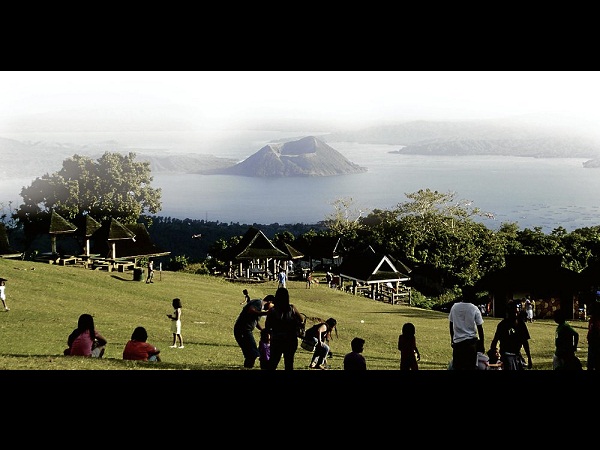
• Tagaytay
Matti said that with a rehabilitated SLEX and increasing developments nearby, Tagaytay and its cooler weather would be a great retirement option.
“An hour’s drive further south gives you the beaches of Batangas, while 40 minutes north gives you Santa Rosa, with Filinvest/Alabang next, and Manila just 20 to 30 minutes after that. Great golf all around, resorts, restaurants and casinos,” Matti enumerated.
Edgar Dizon, CBRE Philippines’ associate director for Investments and Capital Markets, said Tagaytay enjoys that unique characteristic of being both a tourist spot and a retirement haven.
“The cool weather and the calm environment would certainly give the retirees the much-sought-for ‘comfort’ which is difficult to find from other sites where hectic days are predominant. The cost of living may be higher than standard, but cost is relative and even peace, quiet and comfort certainly has a premium for most,” Dizon said.
• Proximity to Metro Manila
For Claro dG. Cordero Jr., head of research, consulting and valuation of Jones Lang LaSalle Leechiu, the areas of Cavite, Laguna, Batangas and Rizal enjoy the proximity to Metro Manila, to advanced health-related facilities, and to recreational facilities. Furthermore, there are properties that can be developed into sustainable communities. Access and assistance of local governments (to encourage locators/developers) is also a major advantage of the corridor.
• Cebu
Matti said this city is a good combination of urban and provincial life. The cost of living is lower than in Manila, but still with enough provincial charm and urban sophistication. There are good schools, plenty of entertainment options and adequate infrastructure. Cebu is also accessible to and from Manila and other places in the south because of the airport and low fares.
“Good food, good beaches and diving spots. The options are aplenty in this queen city of the south,” Matti added.
Calvin Javiniar, CBRE Philippines’ senior director for investments and capital markets, added that “Cebu is a beautiful city characterized by rapid growth and urbanization but still maintains its cultural heritage and spirit.
“It is also both a business hub and a tourist destination which caters well to the needs and wants of upscale retirees, both foreign and domestic. However, the city should still improve on their delivery and quality of medical facilities and services. Cebu City has always been identified as a potential destination for medical tourism.”
• Clark, Pampanga
Matti said the increased developments happening here make this area more interesting by the day. “I know it already is one of the top retirement areas for Americans, but could be a booming area for locals as well. The Subic-Clark-Tarlac Expressway (SCTEX) offers ease of mobility in the region, and having the main airport move there will certainly add to the already rapid change in the area. The food in Pampanga helps, too. But it’s hard to determine at this point what the final face of Clark will look like.”
• Baguio
Matti said traffic in the summer capital of the Philippines has never been worse, especially during the flower festival (Panagbenga) and Holy Week, but the weather and air (depending on the specific location here) is still generally fresher, which is a serious consideration for a retiree. “Travel time has improved with the (progress in) North Luzon Expressway (NLEX) and SCTEX, but is still quite a distance. It would still be difficult to do a day trip to Manila from here,” he added.
• Iloilo, Bacolod
Matti said lower cost of living and the charm of these cities could be top draws for many retirees. “People are definitely friendly and very connected to Manila. Having friends and/or family here will surely help.”
• Dumaguete
Edgar Dizon, CBRE Philippines’ associate director for investments and capital markets, said Dumaguete has “urbanized” immensely over the last few years, but the gentleness and the politeness of the people have remained. Since retirement is about living comfortably, retirees being around good-natured people can certainly make “community” living worthwhile. While local and foreign visitors come in and out for business and leisure, the congestion and (young and adventurous) tourist saturation is not prevalent.
• Metro Manila
Believe it or not, the nation’s capital mega-city has its plus factors for retirees. Cordero said the things going for Metro Manila would be the mature property developments and advanced health-related facilities, as well as the presence of highly developed infrastructure. The biggest downside, however, would be the deteriorating quality of the environment and traffic problems.
• Batangas, Davao, Cagayan de Oro, Clark/Subic corridor
Soriano added that Batangas, Davao, Cagayan de Oro and the Clark/Subic corridor possess most of the required retirement elements. “These locations have the minimum standards for a retirement haven, especially for the active retirees 45 to 75 years old,” Soriano said.
The Metro Cebu, Metro Davao and Subic/Clark corridor are also ideal because of their connectivity. Soriano explained this would be due to the presence of direct flights to Metro Manila and other key cities in the Asia-Pacific region, and availability of properties to be developed into sustainable communities. The perceived problem on power supply in Cebu and the “safety” issues in Davao (and the Mindanao region, in general) should be addressed, however.
• Bohol, Aklan (including Boracay) and Palawan
Cordero said the completion of the new international and local airports would significantly boost the inherent advantages of these locations (which are the availability of properties for development and proximity to recreational/natural attractions). However, the health-related facilities in these areas should be further developed.
• Leyte, Samar, Ilocos region, Naga, Albay, and Quezon, Isabela, Aurora
Cordero said these areas are located near or with improved access to the traditional hubs of growth and development, and should take advantage of this proximity. These areas could be considered the “next wave” areas of development due to availability of suitable properties for development (and for its proximity to natural attractions). To make these places ideal for retirement facilities, the health-related facilities, access/infrastructure development, supply of utilities and further support from the local governments should be enhanced.
• Warm, hospitable
Cordero concluded: “Being a warm, hospitable people and the presence of natural attractions (almost anywhere), we consider any place in the Philippines as the ideal place to accommodate retirees. These areas (specifically mentioned), however, have had the upper-hand in developing the support facilities crucial in developing sustainable retirement facilities.”
Soriano added: “Property developers are averse to calling their projects as ‘retirement villages’ as it has a perceived limiting effect. They are more focused in creating masterplans that appeal to mainstream homebuyers with an incidental component that would attract baby boomers.”

Thursday, May 10, 2012

Legends and surprises in Albay


By: 

share379 368

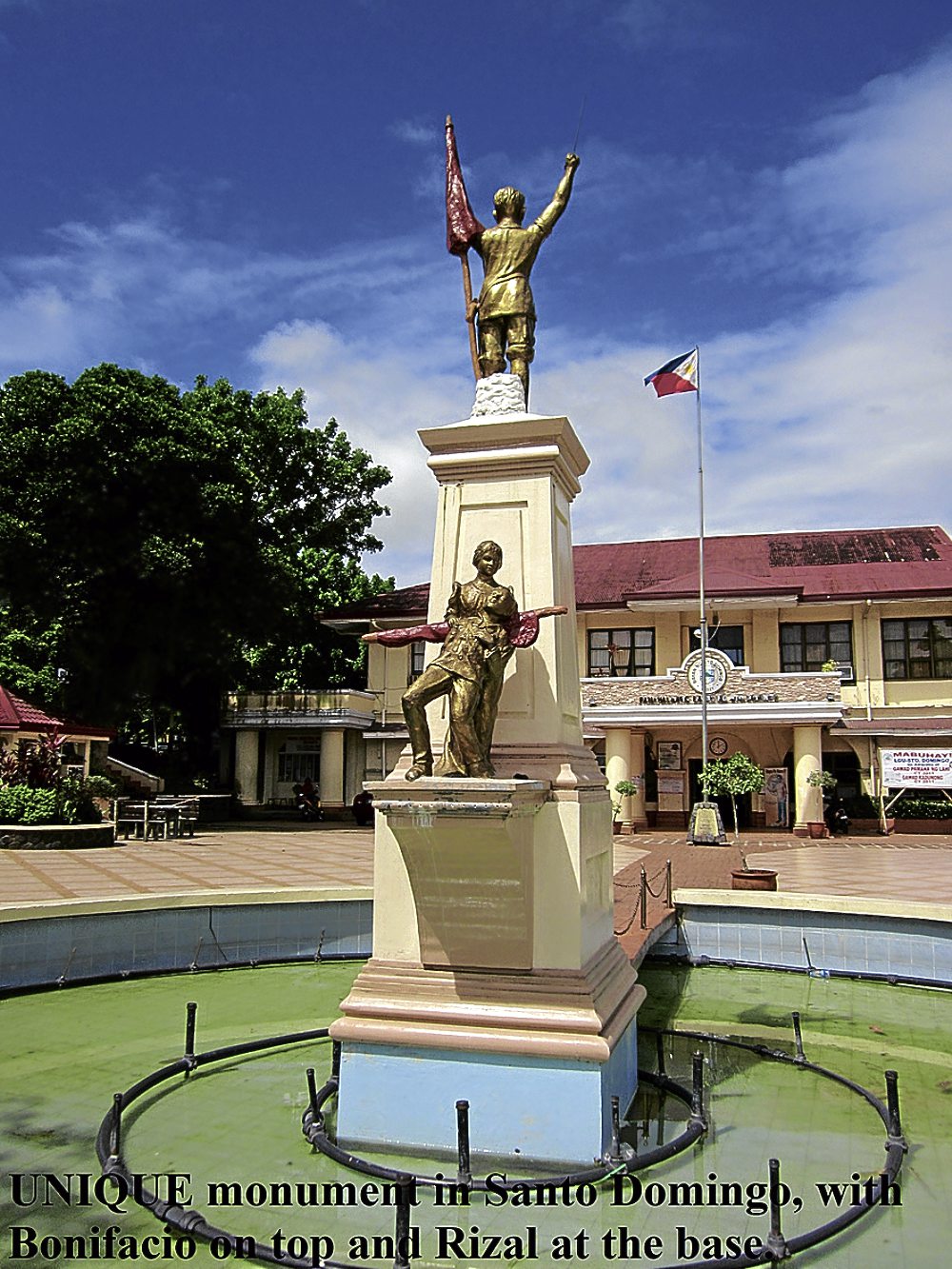
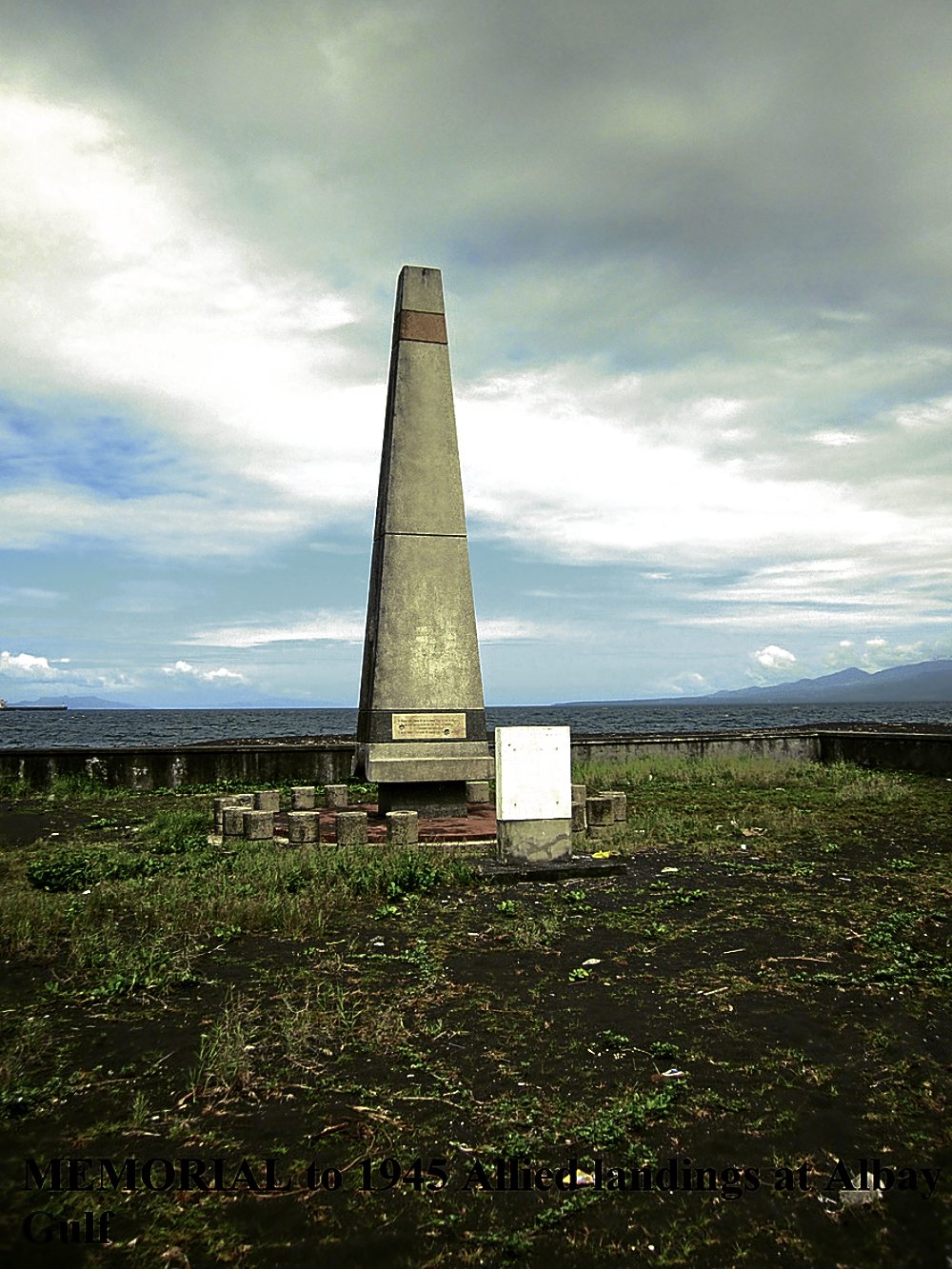
AT FAR left, unique monument in Sto. Domingo, with Bonifacio on top and Rizal at the base; memorial to Allied landings at Albay Gulf
It is the story of three mountains, rather three maidens, a prequel written by poet Jun Balde of Albay who is like every good Bicolano oragon (hot). The three sisters were known as Masaraga, Malinaw and Magayon.
Intrigues and sibling rivalry unfortunately led to the untimely deaths of Masaraga and Malinaw, and so remained only the beautiful Magayon.
The legend continues.
Magayon became part of a love triangle. To save her father from the vicious Paratuga, she agreed to marry him. She despised him; she loved only Panganoron who had saved her from drowning. In fact, she was carrying Panganoron’s love child! OMG.
Things soon came to a head.
Panganoron summoned his followers and, to rescue Magayon, they attacked the wedding feast. In the ensuing fight, both Magayon and her lover were killed.
Magayon’s grave became a hill, which grew and grew and became the majestic Mt. Mayon, one of the most photographed volcanoes in the world.
Magayon festival
The stories and legends concerning Mayon are being relived in the Magayon festival, recently inaugurated in Legazpi City, capital of Albay, by Governor Joey S. Salceda. Guests of honor included Tourism Secretary Ramon Jimenez Jr. and partylist Representative Risa Hontiveros.

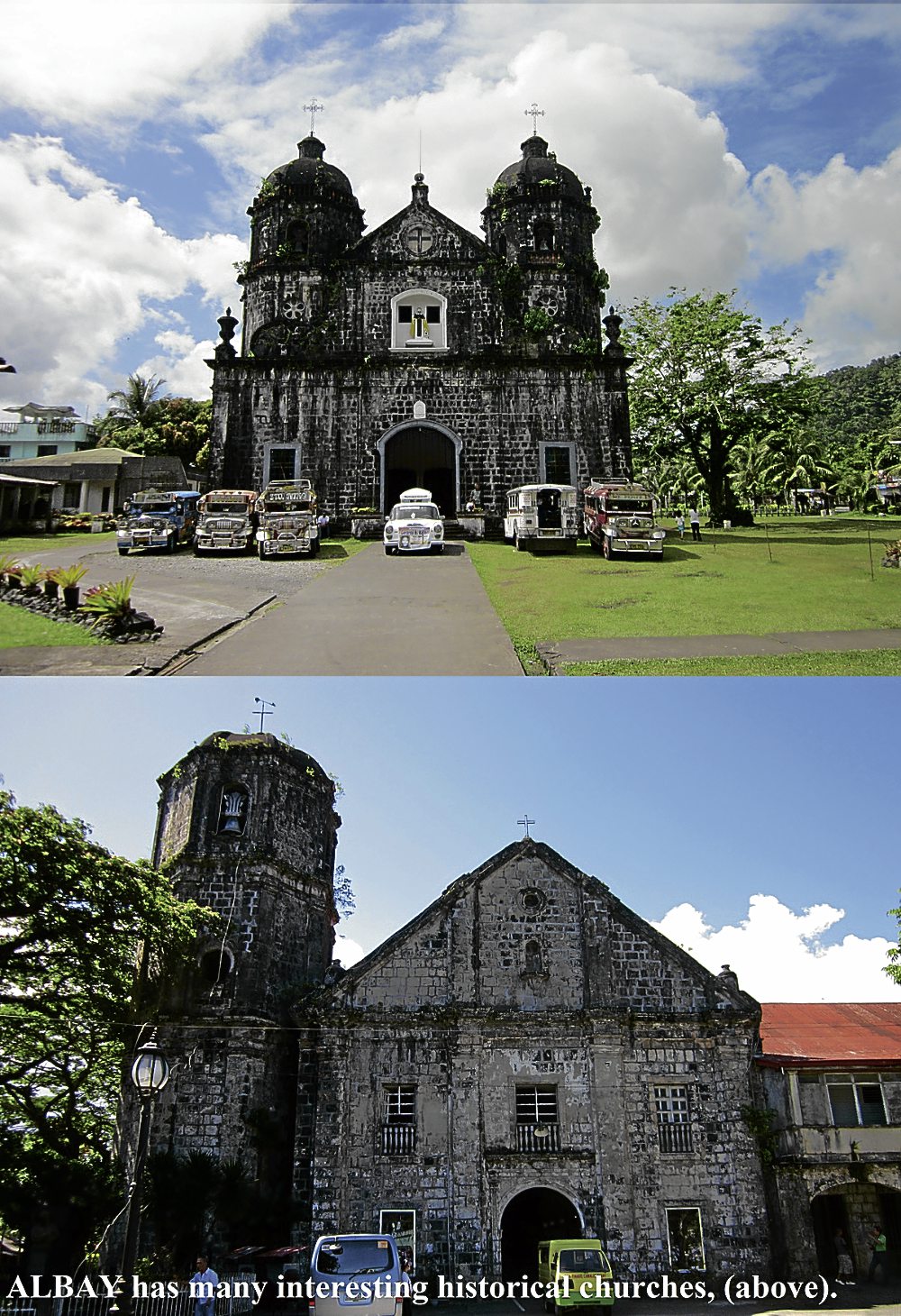
ALBAY has many interesting historical churches.
The month-long festival in this fiesta-crazy province will last until May 10. Among the judges in the dancing competition was actor Jhong Hilario.
That day, competing youths from all over Bicolandia, dressed in all their finery, danced frenziedly, chanted and somersaulted, goaded on by throbbing drums and backdropped by movable giant props.
The festival underscores the provincial government’s thrust toward eco-tourism and economic development. At the same time, Albay is becoming increasingly conscious of its past (Battle of Legazpi, 1900), its heritage museums, archeological sites, ancestral homes, landmarks and memorials, and great churches.
Old churches
Interesting churches in the province include St. Gregory the Great Cathedral in downtown Legazpi; the famous Our Lady of the Gate Parish (now white-washed) in Daraga; the St. John the Baptizer churches in, respectively, Camalig and Tabaco City; St. Lawrence the Martyr Parish in Oas; Nuestra Señora de Salvacion Parish in Joroan, Tiwi, scene of a maritime procession come August; and St. Dominic of Guzman in Sto. Domingo.

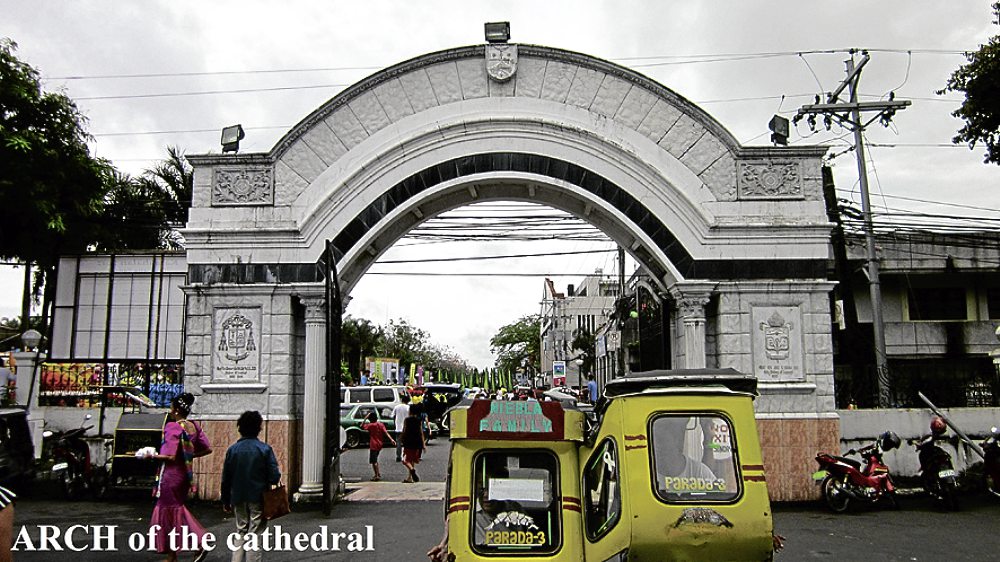
ARCH of the Cathedral
The original church in Sto. Domingo was built in 1765 and destroyed by fire. The people, through polos y servicio (community service), rebuilt it in 1822 with cut stones (piedras labradas).
‘Sarung Banggi’
Sto. Domingo, it turns out, is the hometown of composer Potenciano V. Gregorio, who wrote the immortal song “Sarung Banggi” (One Night) and other Bicolano compositions. It is a lilting song about loneliness conquered by a vision of love.
Gregorio was born here in Libog (the town’s name was mercifully changed to Sto. Domingo in 1959) in 1880, and died of pulmonia in 1939 on his way to the San Francisco exposition.

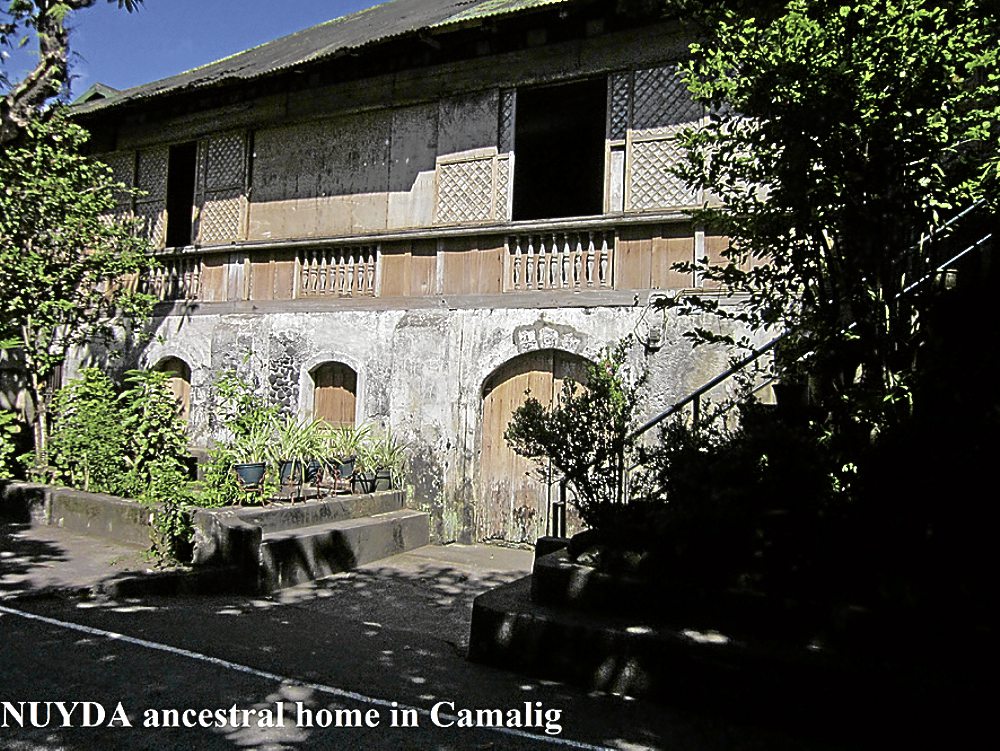
NUYDA ancestral home in Camalig
He is much honored in his hometown, where there is a mausoleum housing his remains along with memorabilia. On May 11-19, Sto. Domingo will stage the 10th Sarung Banggi festival to mark the 132nd birth anniversary of the composer.

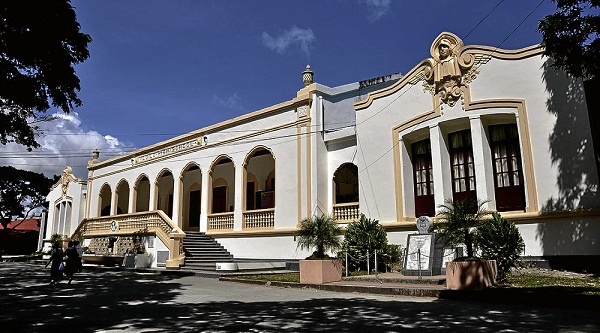
ST. GREGORY the Great Cathedral
Cena Una
Another surprise in Albay is Cena Una in nearby Daraga, an elegant restaurant which used to be an ancestral home. So it still sports the regulation capiz-shell windows and stained-glass doors, and houses precious photos from the late 1890s and early 1900s. There are scenes from Manila and Cebu, with the men formally dressed in white suits (what used to be called americana). On the mezzanine are drawings of great churches in the Philippines.
And that’s not all. The compound includes a tastefully-furnished air-conditioned room with a bathroom, loft (with ladder), TV, pottery, curios and religious symbols.
The price of the room per night is a cavan of rice or its cash equivalent (P1,500). Not a bad deal.
And Albay itself has many things going for it, with the spirit of Magayon hovering over the province.

Wednesday, May 2, 2012

Getting younger in Camarines Norte


Wander Woman
By LUCCI C. CORAL

A temporary floor mirror is created by the waves rushing onto Bagasbas's smooth beach.
MANILA, Philippines — This is a story about how I got five years younger during a weekend trip to Camarines Norte.
My version of premature aging comes with slow metabolism, futile attempts to slim down and a preference for surfing the Internet rather than the waves. However, my recent trip to the province of Camarines Norte brought back my fun side and transformed me from a pathological killjoy into a vibrant young woman who would love to climb every mountain and swim every sea.
I first found myself resisting every opportunity to get wet in the different bodies of water of this province. However, after my mind said “no,” my heart quickly followed it up with a “yes.” So here’s a story about places and activities that were just too hard to resist.
Talon nang Talon sa Talon
I had to miss the overnight camping trip to Calaguas island because of my deadlines’ need for wi-fi and mobile signal so I was left behind at the jump-off point—the municipality of Paracale.  So even if it was heartbreaking to miss the fun, another side of me revved up with excitement about exploring the town of Paracale, which turned out to be a town of gold—literally.
But that is another story which I would be telling in full detail soon.
So let me start at the point when I was back with my group again, in the car going to the municipality of Labo, Camarines Norte. As is usually the case, this town got its name because of miscommunication.  Once upon a time, when the Spaniards came and asked what the name of the town was, the townsfolk thought that they were asking how the water was, and they answered “Labo.” So there you go. Sign language must not have been so effective during that time.
However, what was so clear is the beauty of its Malatap falls. We walked a few meters into the mountain and I started to hear the music of its running water heightened by some splashing. And when Malatap falls finally revealed itself to us, we found this beautiful low-rise waterfall filled with an aura of happiness. It was Saturday and it was the day for the locals of this town to frolic in their natural swimming pool. For the kids, the main activity was climb-jump-climb-jump.
The upper portion of the waterfall had placid waters surrounded by lush greeneries, which looked as if a diwata would appear at any moment. But since she didn’t appear, I took the opportunity to play mountain goddess and took a dip in its waters.
Another unforgettable part of this trip was being naturally hydromassaged by its strong running waters. A local named Moniko (he’s an artist, not a mekaniko), persistently encouraged me to lie down on a certain slope and get the massage. I said “no” at least three times but finally climbed back up, sat on the rocks which seemed to be naturally positioned for human beings to comfortably recline, and let the waters fall hard on my shoulders, while another lighter pour fell on my face.
But since this trip was location-hopping, my natural spa experience had to be cut short. And we went back on the road for another exciting activity.
Kayak Surfing in Mercedes
It was an hour before sunset when we arrived at the Baybay beach of the municipality of Mercedes to go kayak surfing. I knew kayak, I knew surfing, but I had no idea what happens when you put them together. And the constant question came: “Luch, are you trying it?” And the killjoy in me automatically said “I’ll just watch you guys.”
I felt that something was wrong with my decision, so I asked a tourism officer if he had tried kayak surfing. And after he sweetly said, “Nakaka-adik siya,” I literally ran towards the beach, wore the life vest, and asked a kayak-surfing guide named Victor what I needed to do.
So we rode the kayak and began paddling towards the waves. And when a wave announced its arrival, we turned around, paddled some more, and before I knew it, the wave carried us on its shoulder on an accelerating speed back to the shore. Oh, the rush! And after confirming to myself that this activity was far from dangerous, my seemingly unending request from Victor was “Isa pa!”
The beautiful sunset came and we headed to our hotel—the super nice Bagasbas Lighthouse. It was beautifully landscaped, its rooms are ultra-nice and it has free wi-fi! So after leaving our things at the resort, sampling the local delicacies at Paseo de Bienvenides for dinner, the manang in me took its toll. And I went into deep slumber by 9:30 p.m.
Good morning Bagasbas   
 One good thing about being a manang is that you wake up early and enjoy the best of the morning. I woke up at 4:00 a.m. and had an early dose of work. The chilly air, the sound of the waves and a good hot cup of coffee completed the equation to a perfect moment to do the job I brought from Manila. I actually remembered that I love working, after all.
But when the sun started to rise on the waters of the beautiful Bagasbas beach, enjoying the view from our room’s balcony was no longer enough. I had to go down and feel the sand on my feet.
It was Sunday morning and the locals were already there to enjoy the beach. I bought a cup of taho and began walking its long stretch. Some old peeps were doing their morning walks, kids were enjoying their infinite sandbox, while some teens were taking their jumpshot silhouette photos against the rising sun.
The sound of crashing waves mixed with the laughter of people was like happy music. As the waves touch the fine gray sand of the beach, it creates a temporary mirror which reflects the skies painted by the warm colors of sunrise. There, I started forgetting about wi-fi and work, and started remembering how good life is and how every source of happiness seemed to have been already provided by the Creator for us.
Then the question came again, “Are you going surfing?” To which I replied “no” once more. The group went to the beach for the surfing clinic while I continued working at the beachside restaurant with electric outlet and free wifi.
But something felt wrong again. So, I went back up to my room to change and headed straight for the beach to surf the waves. I had a long board and Onyok from Aquamarine Sports did a good job in endlessly encouraging me after every epic fail. And even if I was able to stand up on the surfboard for just a millisecond, it felt fulfilling.
Lunch by the river and dessert by the pond
We were advised not to change into dry clothes anymore because we were bound to get wet again for lunch. This time, I dared not say “no” because my integrity had already failed on this issue. We headed to the Mampurog river at the municipality of San Lorenzo Ruiz, where they have nipa huts for rent for only P100-P150/day. Here you can bring your own food or buy some from a local store, and enjoy dipping into the river in between meals.
And Mampurog river was beautiful! It looked like one of those rivers in ST films where the actress wearing a white shirt frolics into the water. The running water was nicely cool and lush trees framed its stretch. Rocks which broke the current served as massage spots. It’s easy to spend the whole day in this huge bathtub with natural water jets.
While still wet in this province, we headed to the Pineapple Island Resort in Daet, Camarines Norte. And as we relaxed at the pavilion stilted on a nice pond, we had sweet servings of ube turon, ginataang bilo-bilo and chocolate cake.
So this is the story of how I got younger in Camarines Norte. It may not be about finding the eternal fountain of youth but it’s about allowing myself to get wet and plunge into the beauty of nature. The urban jungle and work stress may have aged me a bit, but this weekend trip brought me back to my fun self.
It was another experience which reminded me of how rich our country is and how we have been provided with a variety of springs of joy. We may be richer that we thought, and instead of stressing out to gain more monetary treasures, we might miss out on the fact that we are already sitting on a pot of gold.
It is true that it is more fun in the Philippines, but it is more fun to be a Filipino.

When in Cebu City, please visit gregmelep.com for your real estate and retirement needs.